
 SRR5120930
Upload
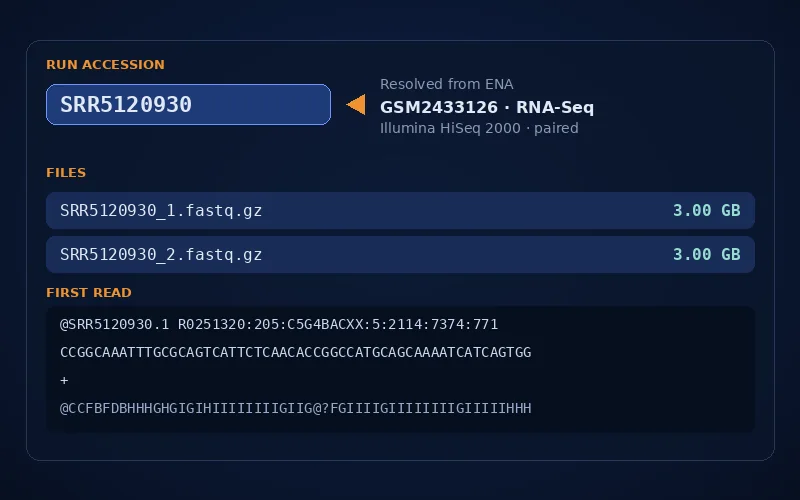
Pull every run straight from an accession list, or upload your own FASTQ files. File integrity and read pairing are checked on arrival.
SRA Toolkit 3.0.3 · Public domainA complete RNA-seq analysis, from a run accession to enrichment, splicing and gene fusions, as a chain of guided forms in a browser. Eleven modules, no Linux, no scripting, and a full parameter record with every job.
A standard RNA-seq analysis chains a dozen steps, from quality assessment to functional interpretation. Mature open-source software exists for every one of them. What costs months is running them in order, because each tool has its own dependencies, formats and parameters, and the output of one rarely fits the next without reshaping.
| Class | No command line | Reads to result in one session | Parameters stored per job | What it leaves to the user |
|---|---|---|---|---|
| Workflow managersNextflow and nf-core, Snakemake, CWL, WDL | No | In part | Yes | Engine installation, configuration profiles, sample sheets and compute set-up all need scripting. |
| Open web platformsGalaxy, GenePattern, Chipster | Yes | In part | Varies | Organised around tools. The user assembles the workflow, matches formats and tracks intermediate files. |
| Commercial cloud environmentsSeven Bridges, DNAnexus, Terra, BaseSpace, Partek Flow | Yes | Varies | Varies | Licence cost and vendor tie-in. Parameters are either fully exposed or hidden entirely. |
| Downstream web applicationsiDEP, BioJupies, ExpressAnalyst, DEBrowser | Yes | No | Varies | The input is a count matrix, so read-level processing, the stage that needs the most Linux skill, stays with the user. |
| Yes | Yes | Yes | Proprietary hosting, and only the integrated engines are available. |
The distinction concerns the unit of work, not quality. Workflow managers remain the better choice for groups that customise pipelines and run them at scale. The gap we built for is the absence of any environment where read-level processing and interpretation run as one guided sequence, with provenance captured throughout.
The main path runs from Upload through quality control, trimming, alignment, quantification and annotation to differential expression and enrichment. Two optional modules branch from alignment and re-run the aligner with the settings their engines need. Any module also runs on its own, so you can enter at the stage matching the data you already hold.
Read level
Alignment level
Interpretation
A trimmed read set, a sorted alignment or a count matrix made by one module is selected directly as the input of the next. Nothing is exported, converted or re-uploaded between stages.
Each form shows only the parameters that matter, with values taken from the engine's own documentation. Accession lists resolve themselves, references are pre-built, and a metadata table is matched to the count matrix before the design formula is accepted.
Every job stores its full parameter set, engine versions, logs and outputs, shown on the result page exactly as submitted. That record is what you copy into the methods section of a paper.
Where a well-tested engine exists we integrate it rather than rewrite it. Each runs unmodified under its original licence and is named with its required citation on every result page.
Pictures are made from the public data of the case study (GEO GSE92592): reads from one control lung sample, its deposited counts and a PyDESeq2 analysis of them, with annotation from g:Profiler and UniProt. The trimming and alignment panels use simple stand-ins (a sliding-window trimmer and minimap2) on a sample of reads, so they illustrate each stage and are not records of a platform run.
From accession to clean reads, with quality checked before and after trimming.
SRR5120930Pull every run straight from an accession list, or upload your own FASTQ files. File integrity and read pairing are checked on arrival.
SRA Toolkit 3.0.3 · Public domain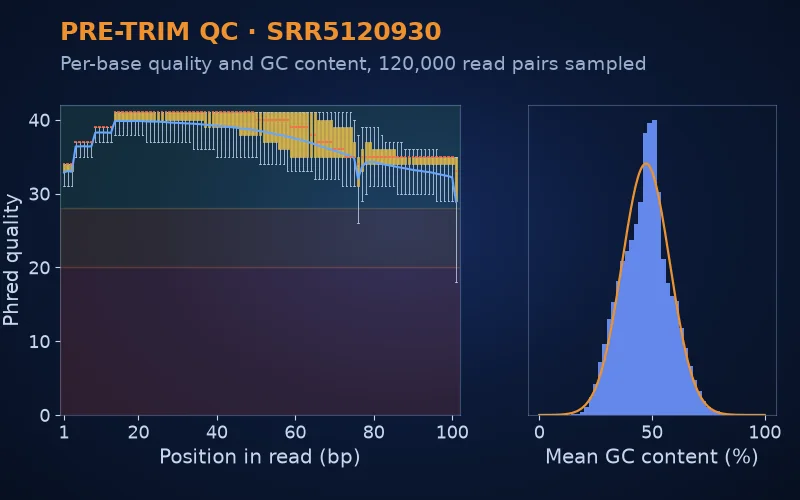 SRR5120930
Per-base quality, GC content, duplication and adapter content for every file, aggregated into one interactive report.
FastQC 0.12.1 · MultiQC 1.35 · GPL-3.0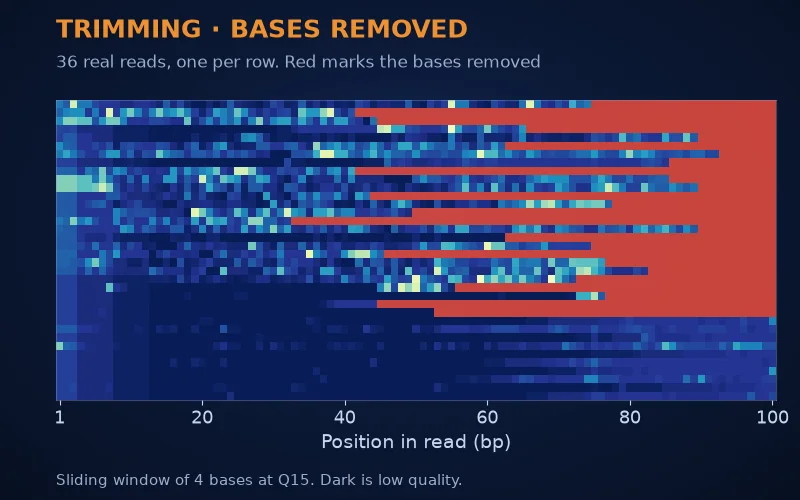 SRR5120930 · stand-in trimmer
Adapter and quality trimming in paired-end mode, so mate relationships survive and only pairs with both mates reach the aligner.
Trimmomatic 0.39 · GPL-3.0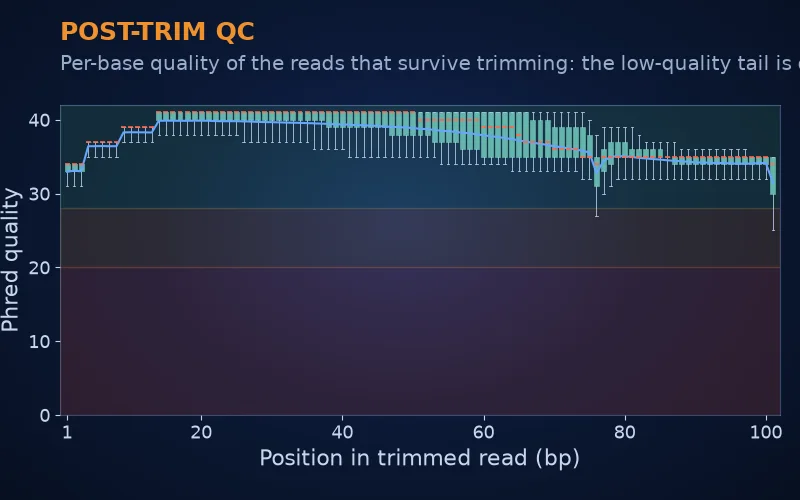 SRR5120930
The same checks again, so you can see exactly what trimming changed before any compute is spent on alignment.
FastQC · MultiQC · GPL-3.0Splice-aware alignment, processing, counting and annotation.
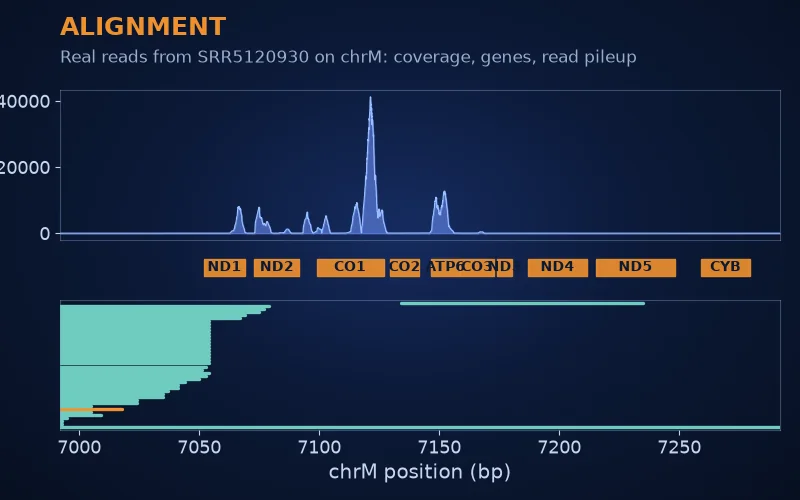 SRR5120930 · chrM
Splice-aware alignment against a pre-built UCSC hg38 index with knownGene annotation. Coordinate-sorted BAM is written directly.
STAR 2.7.11b · hg38 · MIT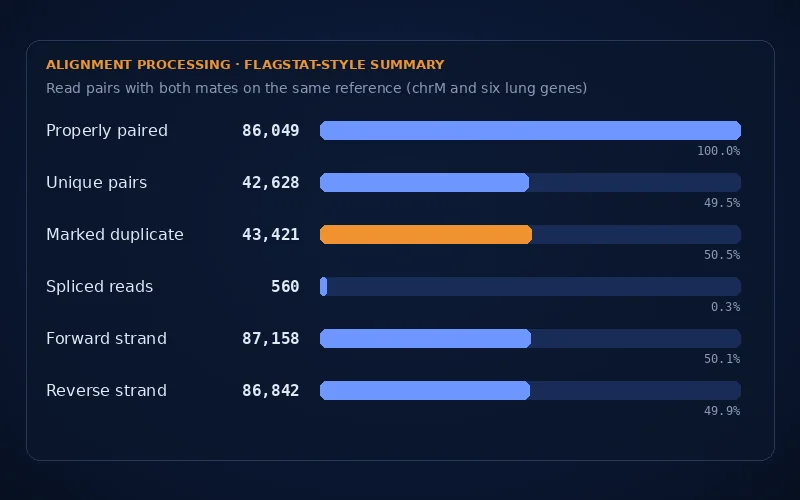 SRR5120930
Sorting, mate fixing, duplicate marking, indexing and flagstat in one pass. Duplicates are flagged rather than discarded, as is usual for RNA-seq.
SAMtools 1.22.1 · MIT / Expat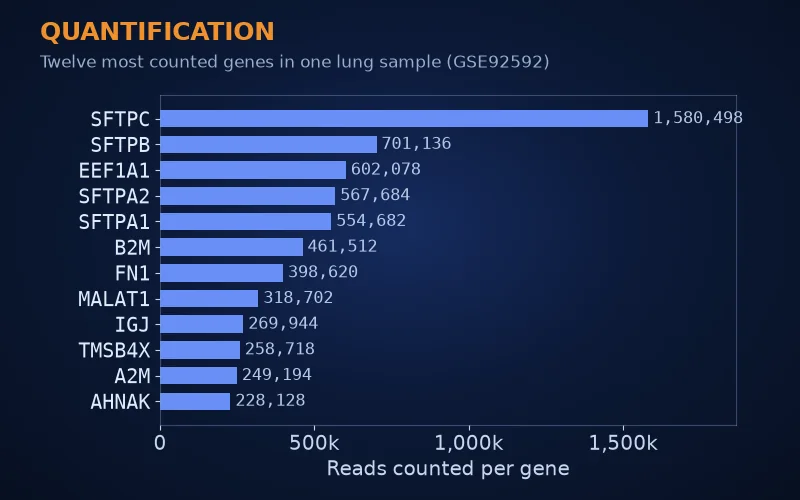 GSE92592 counts
Count read pairs against annotation features with an explicit strandedness setting. featureCounts is offered as an alternative.
HTSeq-count 2.0.5 · GPL-3.0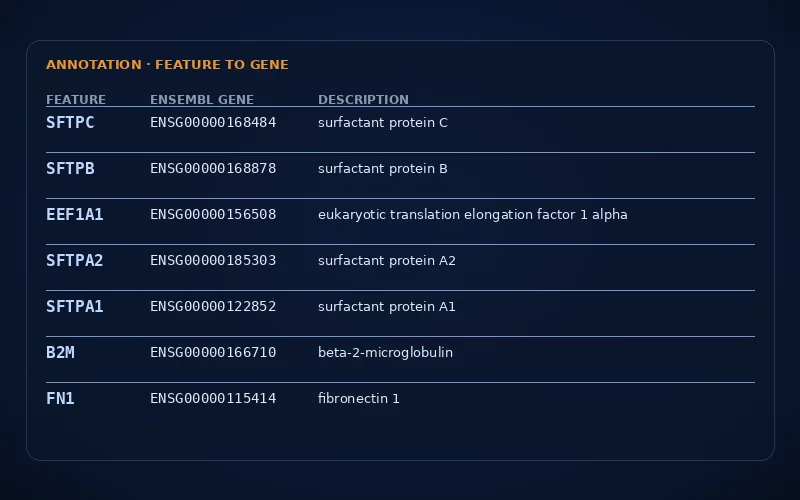 g:Convert
Map feature identifiers to Ensembl genes, HGNC symbols and descriptions, so every table downstream reads in biological terms.
g:Profiler g:Convert · Provider termsDifferential expression and enrichment, with splicing and fusion detection as optional branches from alignment.
 PyDESeq2 · GSE92592
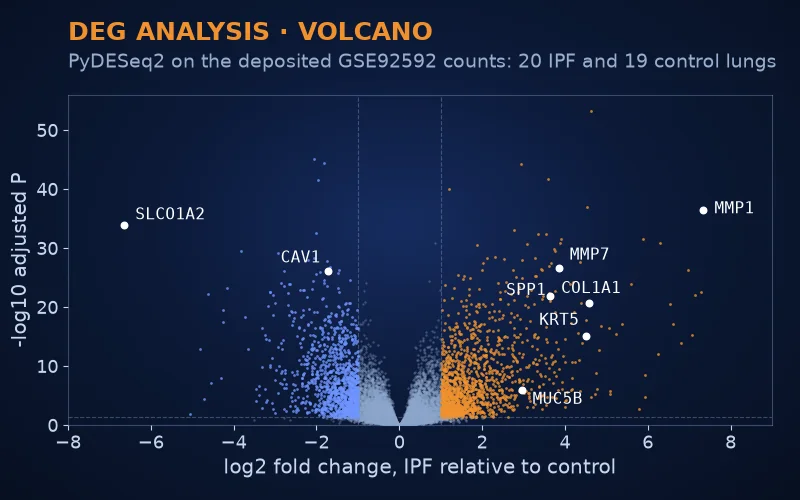
Differential expression with principal components, volcano, MA and heatmap plots, then over-representation analysis and preranked GSEA.
PyDESeq2 0.5.4 · GSEApy 1.3.1 · MIT / BSD-3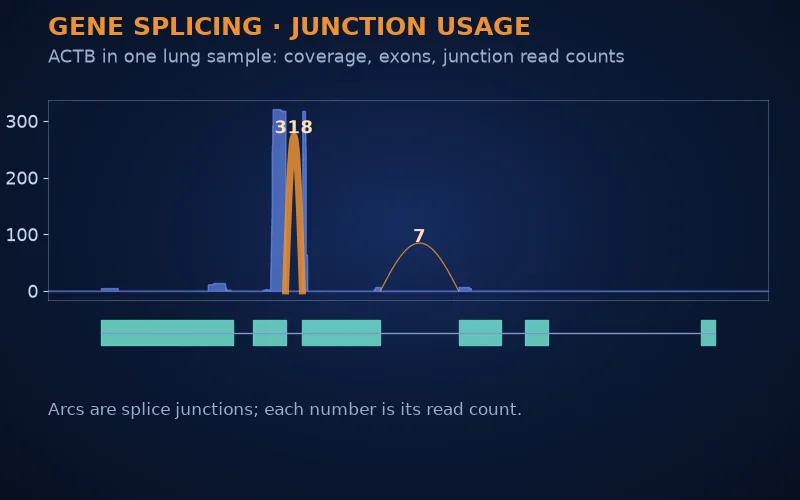 SRR5120930 · ACTB
Junction, exon and gene-level splicing features tested for differential usage, with a self-contained diagnostic report.
splicekit 0.8.1 · edgeR · GPL-3.0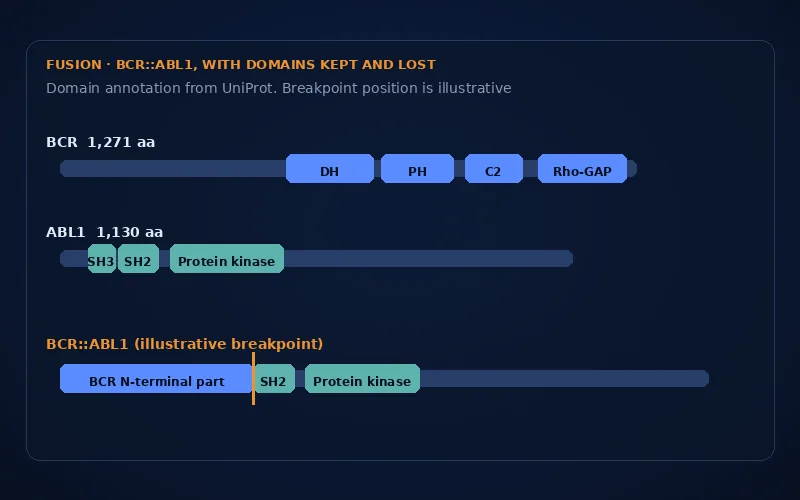 UniProt
Candidate fusions with breakpoints, predicted reading frame, retained protein domains and the reads that support each call.
Arriba 2.5.0 · MITPreparation, validation, orchestration, format conversion and visualisation around each engine were built by us. The algorithms remain the work of their authors, and anyone publishing work run through a module should cite that engine's paper as well as ours.
We ran the whole workflow on public data with well-documented biology: 39 lung samples from idiopathic pulmonary fibrosis patients and control donors, 1.88 billion read pairs. No sample was excluded and no step ran outside the platform.
Thirty-nine lung transcriptomes, run end to end in one session. Each narrowing step is a named module, not a script someone wrote afterwards.
1,714 up-regulated and 1,750 down-regulated in control relative to IPF. The 1,750 down-regulated features are those raised in the fibrotic lung.
Bar lengths on a log scale. GSE92592, 20 IPF and 19 control lung samples.
Matrix metalloproteinases, fibrillar collagens and basal-cell keratins raised in IPF; alveolar epithelial and endothelial genes reduced.
Values are the published fold changes, expressed here as IPF relative to control. The article reports the reciprocal contrast, control relative to IPF.
The result is the accepted biology of the fibrotic lung. MMP7, the first gene identified by expression profiling as a regulator of pulmonary fibrosis, was 14-fold higher in IPF, alongside the interstitial collagenases MMP1 and MMP13. MUC5B, whose promoter variant is the strongest genetic risk factor for the disease, was eight-fold higher.
The six leading terms of the twelve returned, from the 100 most significant genes against GO Biological Process 2023 through Enrichr.
Bars show −log10 of the Benjamini-Hochberg adjusted P value. Preranked GSEA over all tested genes returned 17 sets at FDR below 0.05, all with a negative enrichment score.
Preranked GSEA over all tested genes added the keratinocyte and ciliated-cell programmes of the abnormal epithelium that replaces alveoli in fibrotic lung, which the short input list had missed. All findings are computational and require experimental validation.
A stored parameter set is only worth something if it is sufficient. So we exported the count matrix and the sample metadata and repeated the test on another machine, applying the recorded settings without looking at the original result tables.
Every figure in the case-study metrics above was likewise recomputed from the exported reports rather than copied out of the interface.
Bulk RNA-seq is the first workflow released on this architecture. The rest are being built on it and are not yet available. We would rather tell you what runs today than list what is coming as though it already did.
Read quality control, alignment, capture metrics, duplicate marking, base quality recalibration, variant calling, annotation and filtering.
In developmentThe same path across the whole genome, with structural variant calling and population and clinical annotation.
PlannedBinned coverage corrected for bias, normalised, segmented and called.
In developmentTranslation-level measurement on the same read-processing foundation.
In developmentFrom raw reads or a count matrix, through cell calling, integration, clustering and annotation.
In developmentA choice of gene-level annotations, transcript-level quantification as an alternative to alignment-based counting, and interactive result views.
In developmentRun accessions, FASTQ files, or aligned BAM and CRAM. References and annotations are pre-built, so nothing has to be downloaded or indexed first.
Hosted by us, deployed in your own cloud, or installed on your own servers for data that cannot leave the building.
The method is described in a manuscript currently under review at Functional & Integrative Genomics. We will link the published article here as soon as it is available.