Deeptech · AI-driven Bioinformatics & Drug Discovery Bengaluru, India
Request a demo
Research

Methods proven
in public.

SilicoScientia is a research-led company that develops the tools it uses. Our methods are published in the peer-reviewed literature, and both technologies were validated in the same body of work. Our publications since 2024 span tuberculosis, oncology, antimicrobial resistance, antifungal, antiviral and neurological targets, with several campaigns run end to end on SilicoXplore. The OmicsXplore validation study is currently under review and is listed separately below.

TuberculosisMenT3 · KasA · TMK · …OncologyEGFR · VEGFR-2 · Chk1 · ERK2 · …Antimicrobial resistanceNDM-1 · Ribosomal RNAAntifungalGPI anchored wall transf… · …NeurologicalPDE10A · AChEAntiviralHCV IRESPeer reviewedresearch
30+Peer reviewed papers
7+Run on SilicoXplore
6+Therapeutic areas
19+Journals
2024First publication
How we validate

How we check
our own results.

A number from a docking run means little until the method has been tested against answers that are already known. These are the checks reported in the SilicoXplore platform paper and in the OmicsXplore validation study.

0.840 Å

Redock RMSD

The crystallographic ligand of NDM-1 was docked back into its own structure, and the pose it returned sat within 0.840 Å of the crystal pose.

SilicoXplore platform paper
4,247

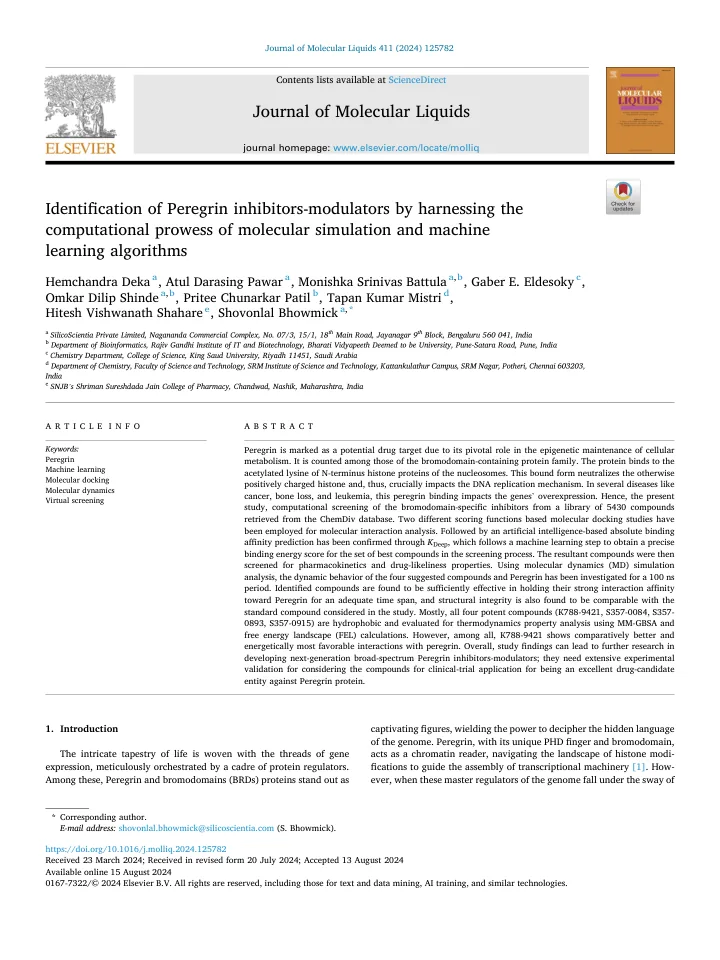
Property matched decoys

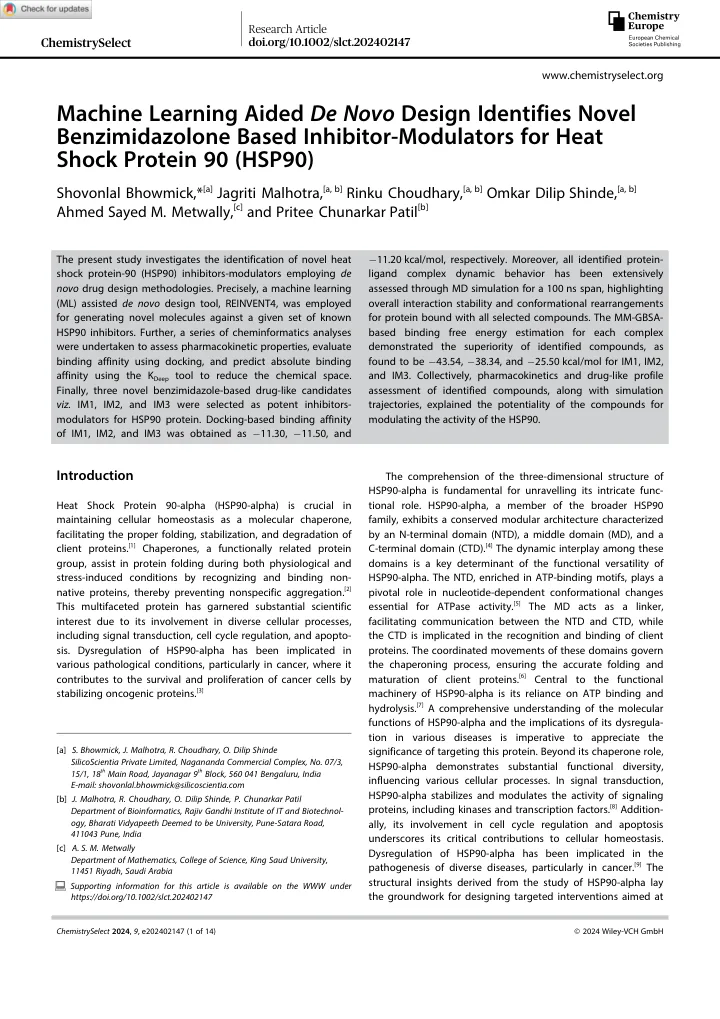
Docking was also tested retrospectively, on how well it separates known actives from 4,247 decoys matched to them on molecular properties.

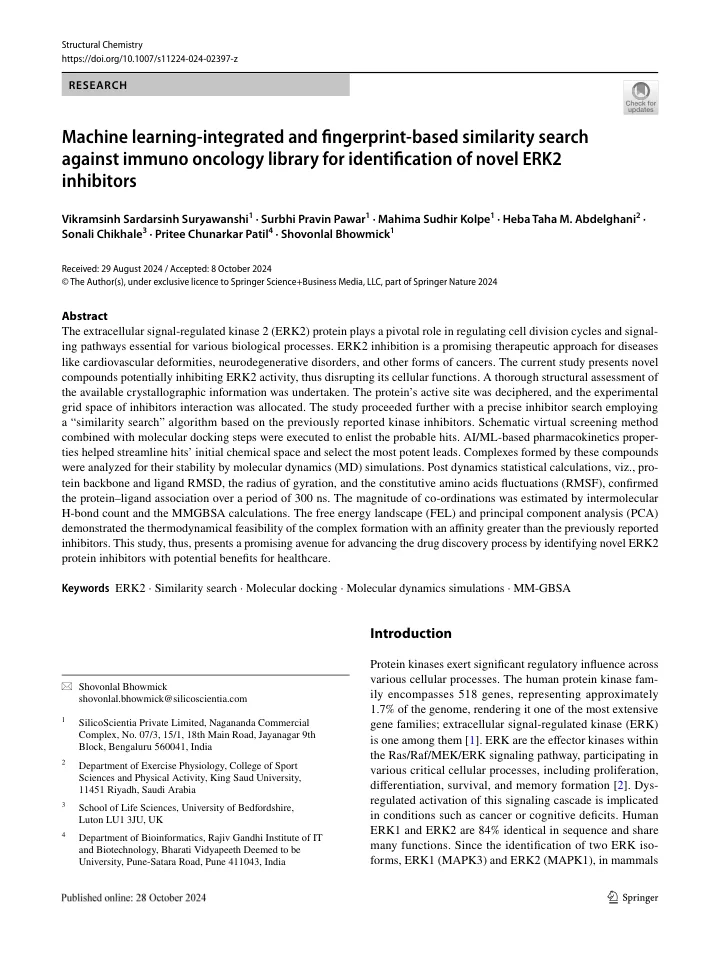
SilicoXplore platform paper
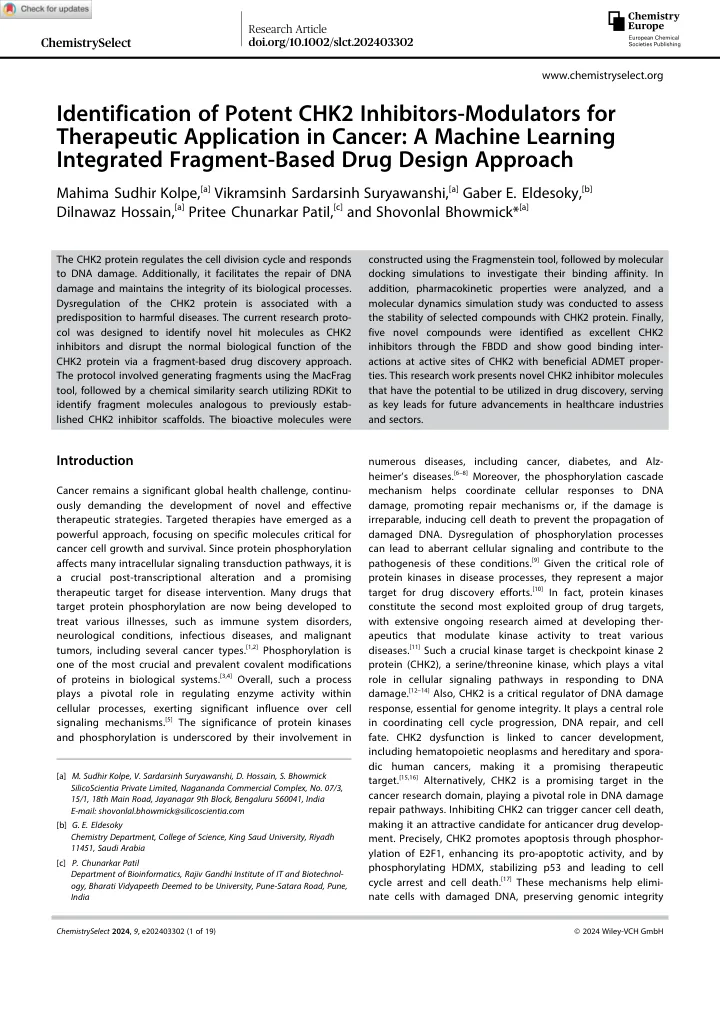
Identical

Independent re-run

In the OmicsXplore pulmonary fibrosis study, a second run from the exported counts reproduced identical significance calls.

OmicsXplore manuscript
Every job

Full parameter trail

Each job stores its parameters, engine versions, logs and outputs, so a result can be traced back to how it was produced.

Both platforms
Powered by SilicoXplore

Research we run on
our own platform.

SilicoXplore is how we do the work, not only what we sell. The paper that introduces the platform, the paper on its machine-learning QSAR module, SilicoSAR, and a series of published campaigns were all run end to end on it, across tuberculosis, oncology, antimicrobial resistance and antifungal targets. Each one carries the full parameter trail that the platform records.

Case study · NDM-1From 455 known actives to four nominated moleculesNDM-1 hydrolyses almost the whole β-lactam class and no inhibitor has reached the clinic.
752,436Generated de novo36% kept269,490ML classified8.2% kept21,975ADMET filtered6.6% kept1,442Shape matched8.5% kept122Synthesis ready3.3% kept4Nominated
455curated seed actives
5successive filters
4candidates nominated
Flagship · the platform paper

SilicoXplore: An integrated cloud platform coupling machine learning with physics-based modelling for end-to-end drug discovery, applied to the computational prioritisation of putative New Delhi metallo-β-lactamase-1 binders

Journal of Molecular Graphics and Modelling, 149 (2026) 109566

Parth Mangal, Omkar Shinde, Sonali Chikhale, Shovonlal Bhowmick, Md Ataul Islam

In plain termsA cloud platform that takes a drug target from a set of known actives to a short list of candidate molecules in one session, shown here on an enzyme that makes many antibiotics ineffective.

The paper that introduces the platform. Applied to NDM-1, a generative run produced 752,436 molecules from 455 seed actives and the cascade narrowed them to four.

752,436molecules generated
4nominated
31platform modules
Read the paper
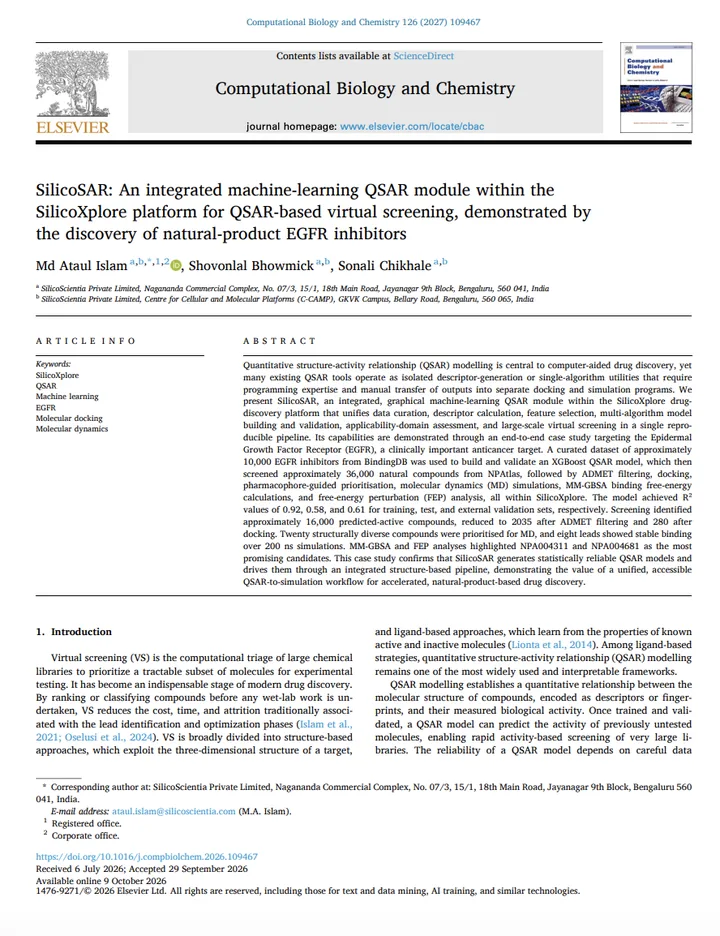
Case study · EGFRFrom 36,000 natural products to eight leadsEach stage ran in a named SilicoXplore module, with no file exported between them.
  1. NPAtlas natural products screened36,000SilicoSAR
  2. Predicted active, pIC50 above 616,000SilicoSAR
  3. Passed ADMET filtering2,035PharmK-AI
  4. Docked at 7.5 kcal/mol or better280LigandLock
  5. Taken into molecular dynamics20SilicoMD
  6. Stable over 200 ns of dynamics8SilicoGBSA, SilicoFEP
0.92R² on training data
0.61R² on the external set
8leads carried to free energy
Module paper · SilicoSAR

SilicoSAR: an integrated machine-learning QSAR module within the SilicoXplore platform for QSAR-based virtual screening, demonstrated by the discovery of natural-product EGFR inhibitors

Computational Biology and Chemistry, volume 126, article 109467

Md Ataul Islam, Shovonlal Bhowmick, Sonali Chikhale

In plain termsThe machine-learning module of SilicoXplore that predicts how strongly a molecule will bind a target. It was built, tested on compounds it had never seen, and used to search a large library of natural products for new cancer drug candidates.

SilicoSAR takes a team from a dataset of known actives to a validated prediction model and a screened library in one graphical workflow, with no code and no manual hand-off to the docking and simulation modules that follow. Applied to the cancer target EGFR, it screened 36,000 natural products and the cascade narrowed them to eight leads, two of which were the most promising by free-energy analysis.

Another peer reviewed paper on a SilicoXplore module, and a further acceptance of the technology by the scientific community.

Read the paper SilicoSAR on the platform page
MenT3TB

Identification of potential MenT3 inhibitors for Mycobacterium tuberculosis using the generative artificial intelligence and SilicoXplore platform

In plain termsDesigned and screened new candidate molecules, on a computer, against a toxin made by the bacterium that causes tuberculosis.

SilicoXplore ran the full campaign against the mycobacterial toxin MenT3. Around 100,000 de novo molecules were generated, filtered by ADMET and pharmacophore to 11,625 and then 1,724, carried through triplicate docking to 1,481 hits, and shortlisted to fourteen. Molecular dynamics, MM-GBSA and density functional theory on the top five confirmed stable binding.

100,000145
Scientific ReportsOpen access
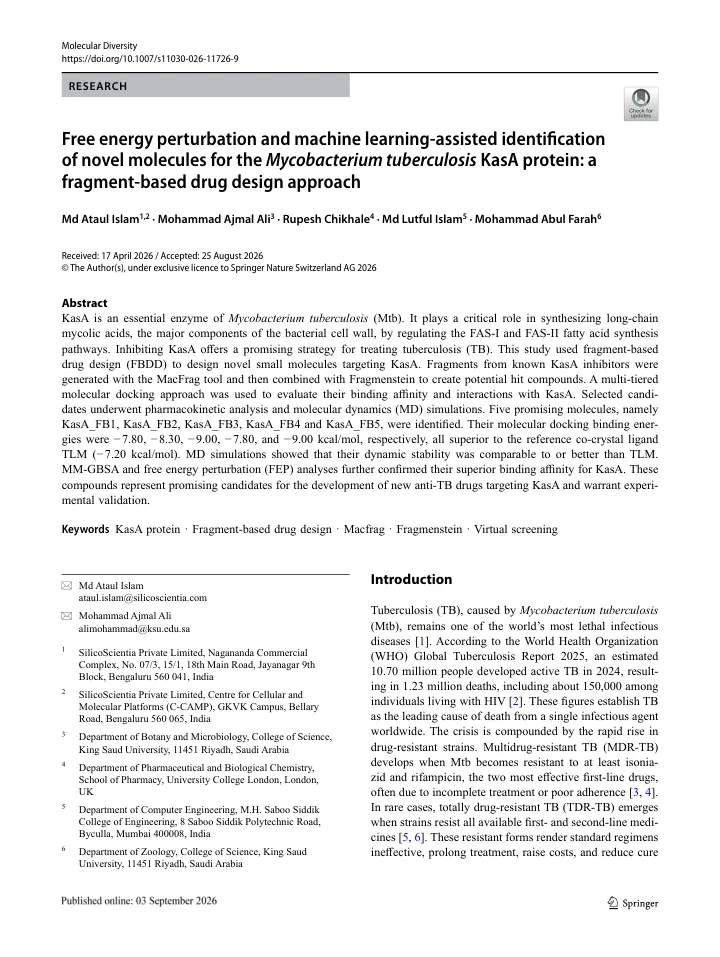
KasATB

Free energy perturbation and machine learning-assisted identification of novel molecules for the Mycobacterium tuberculosis KasA protein: a fragment-based drug design approach

In plain termsBuilt candidate molecules from small fragments against KasA, an enzyme the tuberculosis bacterium uses to build its cell wall.

A fragment based campaign on SilicoXplore combined MacFrag and Fragmenstein to assemble hits against KasA, then ranked them through multi tiered docking, molecular dynamics, MM-GBSA and free energy perturbation. Five molecules were nominated, all with docking energies superior to the co-crystal reference.

5-9.0FEP
Molecular Diversity
VEGFR-2Oncology

Applying artificial intelligence and machine learning framework for de novo design of pyrazole-based VEGFR-2 inhibitors

In plain termsDesigned new molecules from scratch against VEGFR-2, a protein that helps tumours grow the blood vessels they need.

SilicoXplore designed pyrazole based inhibitors of the angiogenesis target VEGFR-2 from scratch, generating candidates, filtering on predicted pharmacokinetics, and confirming the survivors through docking and molecular dynamics.

de novoMD
Journal of Molecular Graphics and Modelling
Chk1Oncology

Free energy perturbation-assisted identification of checkpoint kinase 1 targeted small-molecule inhibitors for cancer therapy using AI- and physics-driven molecular design

In plain termsLooked for molecules that block Chk1, a protein that cancer cells rely on to repair damage to their DNA.

Working against the DNA damage response kinase Chk1, SilicoXplore paired generative design with machine learning triage and closed with free energy perturbation, the most rigorous of the platform's binding affinity methods.

FEPML
Computational Biology and Chemistry
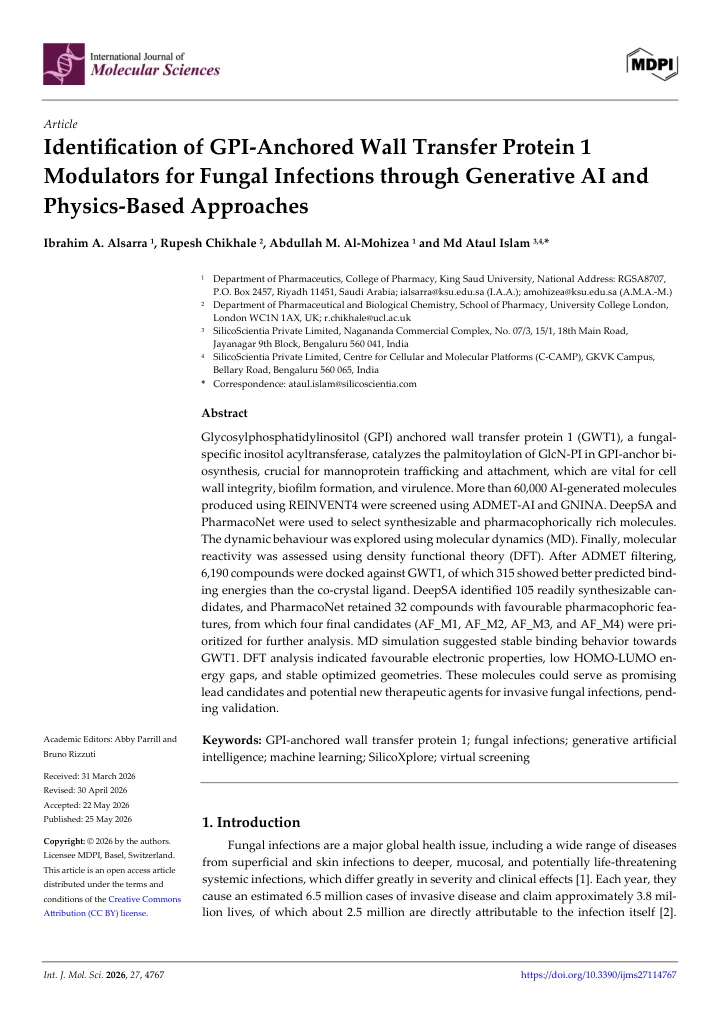
GPI anchored wall transfer protein 1Antifungal

Identification of GPI-Anchored Wall Transfer Protein 1 Modulators for Fungal Infections Through Generative AI and Physics-Based Approaches

In plain termsDesigned candidate molecules against a protein that fungi need to build their cell wall.

SilicoXplore applied the same generative and physics based cascade to a fungal cell wall target, nominating four candidate modulators with the full parameter trail behind each.

4fungal
International Journal of Molecular SciencesOpen access
CYP51BAntifungal

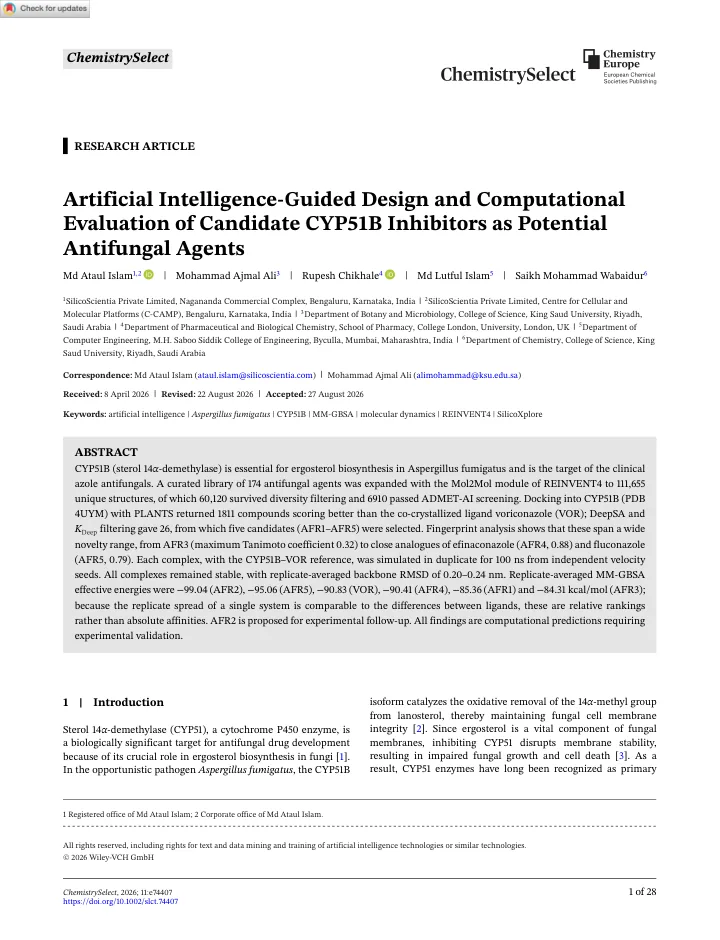
Artificial Intelligence-Guided Design and Computational Evaluation of Candidate CYP51B Inhibitors as Potential Antifungal Agents

In plain termsDesigned candidate molecules against CYP51B, an enzyme fungi use to make their membrane sterols and a proven antifungal target.

SilicoXplore designed and evaluated candidate inhibitors of the fungal sterol biosynthesis enzyme CYP51B, a clinically validated antifungal target.

AI guidedantifungal
ChemistrySelect
Powered by OmicsXplore

Evidence for
OmicsXplore.

OmicsXplore is validated on a pulmonary fibrosis study that is currently under review. It is shown here so that the evidence for both technologies sits in one place, and it is not counted among the peer reviewed papers.

Manuscript · under review

Idiopathic pulmonary fibrosis: 39 lung transcriptomes, from reads to enrichment in one guided run

In plain termsThe software took raw sequencing data from 39 lung samples through to an interpretable result in a single guided run, and a second run reproduced the same calls.

Transcriptomes from patients with idiopathic pulmonary fibrosis and control donors were taken from raw reads to functional enrichment. Matrix metalloproteinases, fibrillar collagens and basal keratins led the down regulated set, and extracellular matrix organisation dominated both over representation and preranked gene set enrichment. The optional splicing and fusion modules ran in the same session. A second independent run from the exported counts reproduced identical significance calls.

Battula M, Mangal P, Shinde O, Chikhale S, Bhowmick S, Islam MA. Manuscript under review.

All findings are computational.

39Lung transcriptomes, patients and control donors
89.6%Read pairs kept after trimming
98.2%Retained pairs aligned to hg38
3,464Features differentially expressed, of 10,484 tested
1,714 / 1,750Up and down regulated genes
38,909Differential splice junctions
271Candidate fusion events
IdenticalSignificance calls on an independent re-run
Research by area

Where the work is pointed.

What the work in each of the six therapeutic areas is aimed at.

Tuberculosis

Our largest body of work, across the mycobacterial cell wall, fatty acid synthesis, dormancy and the toxin antitoxin system.

Oncology

Kinases and regulators central to proliferation and the DNA damage response, from VEGFR-2 and the Aurora and checkpoint kinases to protein protein complexes.

Antifungal

Cell wall biosynthesis and sterol pathway targets, addressing the rising clinical burden of resistant fungal infection.

Neurological

Enzyme targets in Alzheimer's disease and in neurodegenerative and psychiatric disorders.

Antiviral

Structured viral RNA targets, including the hepatitis C internal ribosome entry site.

Antimicrobial resistance

Enzymes that defeat front line antibiotics, including the metallo beta lactamase that resists the carbapenems.

Publications

The complete record.

Every peer reviewed paper from the group, newest first, with the authors and the journal as published. Open any row with the plus sign for a summary and the first page of the article. Filter by area, by technology or by open access. Names that are underlined belong to members of our team.
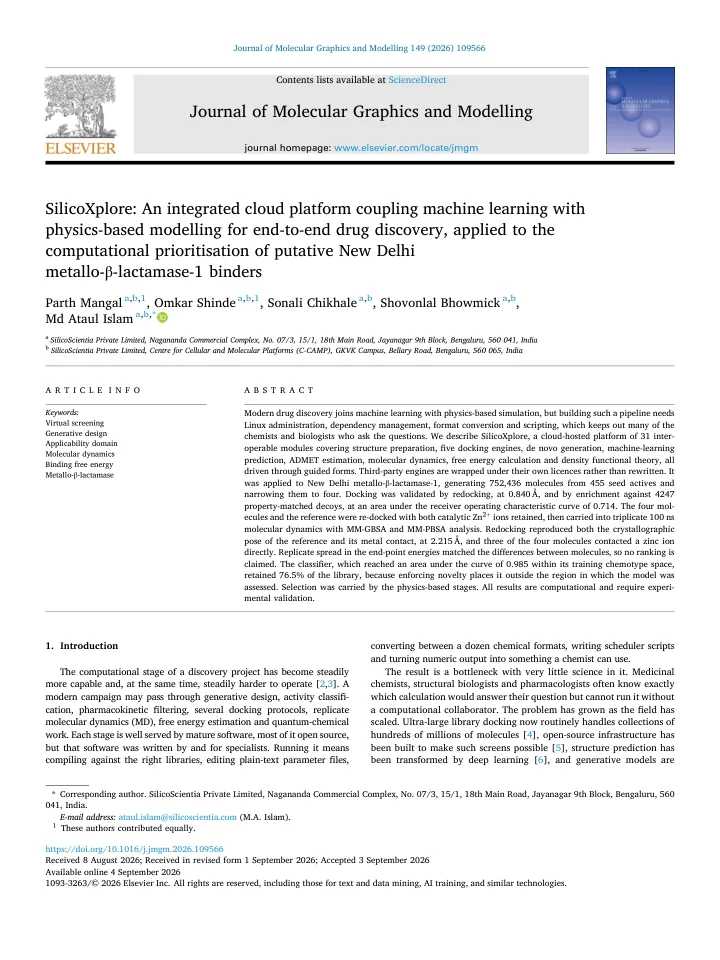
01Antimicrobial resistanceNDM-1SilicoXplore: An integrated cloud platform coupling machine learning with physics-based modelling for end-to-end drug discovery, applied to the computational prioritisation of putative New Delhi metallo-β-lactamase-1 bindersParth Mangal, Omkar Shinde, Sonali Chikhale, Shovonlal Bhowmick, Md Ataul IslamJournal of Molecular Graphics and Modelling2026SilicoXploreShow summary
First page of the article: SilicoXplore: An integrated cloud platform coupling machine learning with physics-based modelling for end-to-end drug discovery, applied to the computational prioritisation of putative New Delhi metallo-β-lactamase-1 bindersFirst page

Summary

Describes SilicoXplore, a cloud-hosted platform of 31 interoperable modules that joins machine learning and physics-based simulation behind guided forms. Applied to NDM-1, it generated 752,436 molecules from 455 seed actives and narrowed them to four candidates, with docking validated by redocking and decoy enrichment, followed by replicate 100 ns molecular dynamics.

Journal
Journal of Molecular Graphics and Modelling
Published
2026 · Volume 149 · 109566
Therapeutic area
Antimicrobial resistance
Target
NDM-1
Technology
Run on SilicoXplore
Access
Subscription journal
Read the article
02OncologyEGFRSilicoSAR: an integrated machine-learning QSAR module within the SilicoXplore platform for QSAR-based virtual screening, demonstrated by the discovery of natural-product EGFR inhibitorsMd Ataul Islam, Shovonlal Bhowmick, Sonali ChikhaleComputational Biology and Chemistry2026SilicoXploreShow summary
First page of the article: SilicoSAR: an integrated machine-learning QSAR module within the SilicoXplore platform for QSAR-based virtual screening, demonstrated by the discovery of natural-product EGFR inhibitorsFirst page

Summary

Introduces SilicoSAR, the machine-learning QSAR module of SilicoXplore, which covers data curation, descriptor calculation, feature selection, multi-algorithm model building, validation, applicability-domain assessment and virtual screening in one graphical pipeline. In an EGFR case study, an XGBoost model built on about 10,000 BindingDB inhibitors (R² 0.92 training, 0.58 test, 0.61 external) screened about 36,000 NPAtlas natural products, followed by ADMET filtering, docking, 200 ns molecular dynamics, MM-GBSA and free-energy perturbation. Eight leads were carried forward, with NPA004311 and NPA004681 the most promising.

Journal
Computational Biology and Chemistry
Published
2026 · Volume 126 · 109467
Therapeutic area
Oncology
Target
EGFR
Technology
Run on SilicoXplore
Access
Subscription journal
Read the article
03AntifungalGPI anchored wall transfer protein 1Identification of GPI-Anchored Wall Transfer Protein 1 Modulators for Fungal Infections Through Generative AI and Physics-Based ApproachesIbrahim A. Alsarra, Rupesh Chikhale, Abdullah M. Al-Mohizea, Md Ataul IslamInternational Journal of Molecular Sciences2026SilicoXploreOpen accessShow summary
First page of the article: Identification of GPI-Anchored Wall Transfer Protein 1 Modulators for Fungal Infections Through Generative AI and Physics-Based ApproachesFirst page

Summary

Screens more than 60,000 AI-generated molecules (REINVENT4) against GWT1, a fungal-specific enzyme in GPI-anchor biosynthesis, through ADMET filtering, docking, synthesisability and pharmacophore selection, molecular dynamics and density functional theory. Four candidates are prioritised as potential leads for invasive fungal infections, pending validation.
Journal
International Journal of Molecular Sciences
Published
2026 · Volume 27 · Issue 11 · 4767
Therapeutic area
Antifungal
Target
GPI anchored wall transfer protein 1
Technology
Run on SilicoXplore
Access
Open access
Read the article
04AntifungalCYP51BArtificial Intelligence-Guided Design and Computational Evaluation of Candidate CYP51B Inhibitors as Potential Antifungal AgentsMd Ataul Islam, Mohammad Ajmal Ali, Rupesh Chikhale, Md Lutful Islam, Saikh Mohammad WabaidurChemistrySelect2026SilicoXploreShow summary
First page of the article: Artificial Intelligence-Guided Design and Computational Evaluation of Candidate CYP51B Inhibitors as Potential Antifungal AgentsFirst page

Summary

Expands a library of 174 antifungal agents to more than 111,000 structures with REINVENT4, then filters by diversity, ADMET and docking against Aspergillus fumigatus CYP51B. Five candidates were simulated in duplicate for 100 ns, and one, AFR2, is proposed for experimental follow-up. All findings are computational predictions requiring experimental validation.
Journal
ChemistrySelect
Published
2026 · Volume 11 · Issue 34 · e74407
Therapeutic area
Antifungal
Target
CYP51B
Technology
Run on SilicoXplore
Access
Subscription journal
Read the article
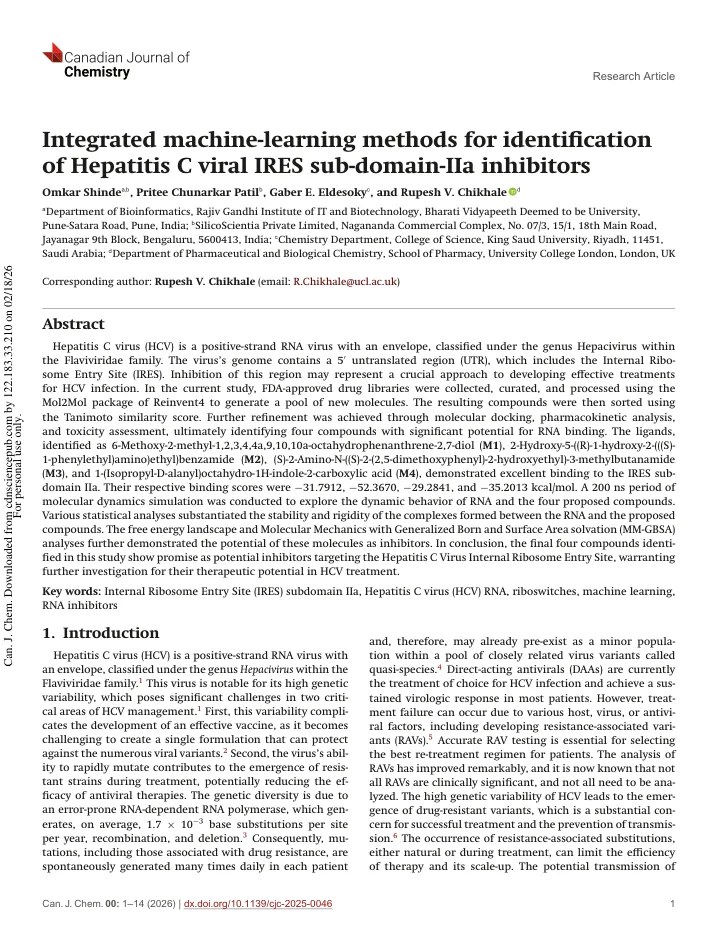
05AntiviralHCV IRESIntegrated machine-learning methods for identification of Hepatitis C viral IRES sub-domain-IIa inhibitorsOmkar Shinde, Pritee Chunarkar Patil, Gaber E. Eldesoky, Rupesh V. ChikhaleCanadian Journal of Chemistry2026Show summary
First page of the article: Integrated machine-learning methods for identification of Hepatitis C viral IRES sub-domain-IIa inhibitorsFirst page

Summary

Generates new molecules from FDA-approved drug libraries with REINVENT4 and refines them by similarity, docking, pharmacokinetic and toxicity assessment. Four compounds bind sub-domain IIa of the hepatitis C virus IRES, an RNA target, and 200 ns molecular dynamics examines the stability of each complex.
Journal
Canadian Journal of Chemistry
Published
2026 · Volume 104 · Issue 3 · 289-302
Therapeutic area
Antiviral
Target
HCV IRES
Access
Subscription journal
Read the article
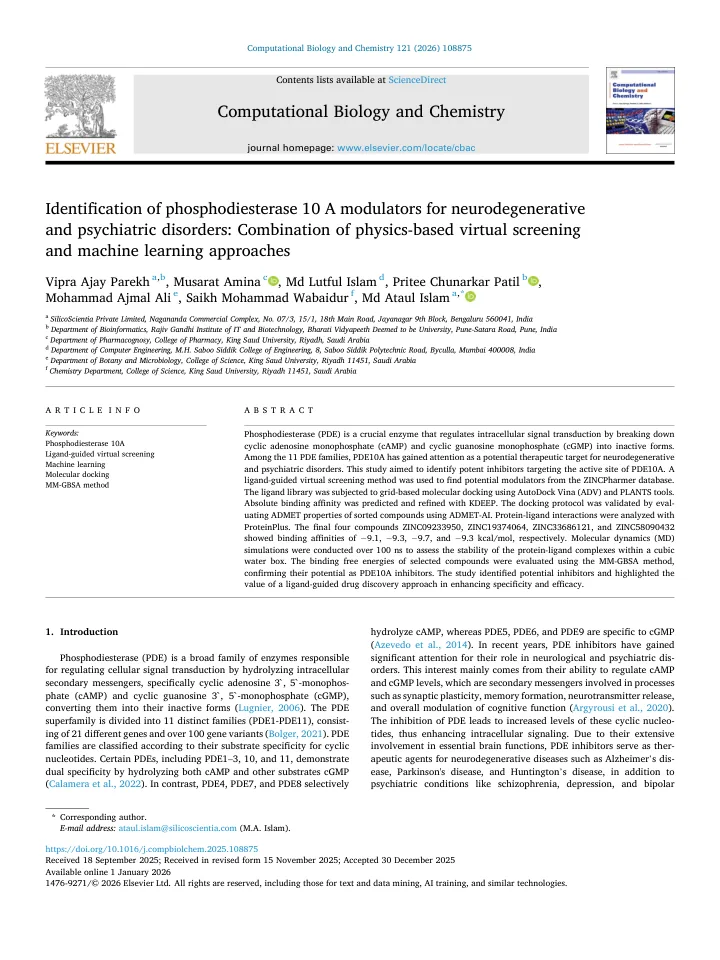
06NeurologicalPDE10AIdentification of phosphodiesterase 10 A modulators for neurodegenerative and psychiatric disorders: Combination of physics-based virtual screening and machine learning approachesVipra Ajay Parekh, Musarat Amina, Md Lutful Islam, Pritee Chunarkar Patil, Mohammad Ajmal Ali, Saikh Mohammad Wabaidur, Md Ataul IslamComputational Biology and Chemistry2026Show summary
First page of the article: Identification of phosphodiesterase 10 A modulators for neurodegenerative and psychiatric disorders: Combination of physics-based virtual screening and machine learning approachesFirst page

Summary

Uses a ligand-guided virtual screen of the ZINCPharmer database, docking with two engines and machine-learning binding-affinity prediction to identify four candidate inhibitors of PDE10A, a target for neurodegenerative and psychiatric disorders. 100 ns molecular dynamics and MM-GBSA support the stability and binding of the complexes.
Journal
Computational Biology and Chemistry
Published
2026 · Volume 121 · 108875
Therapeutic area
Neurological
Target
PDE10A
Access
Subscription journal
Read the article
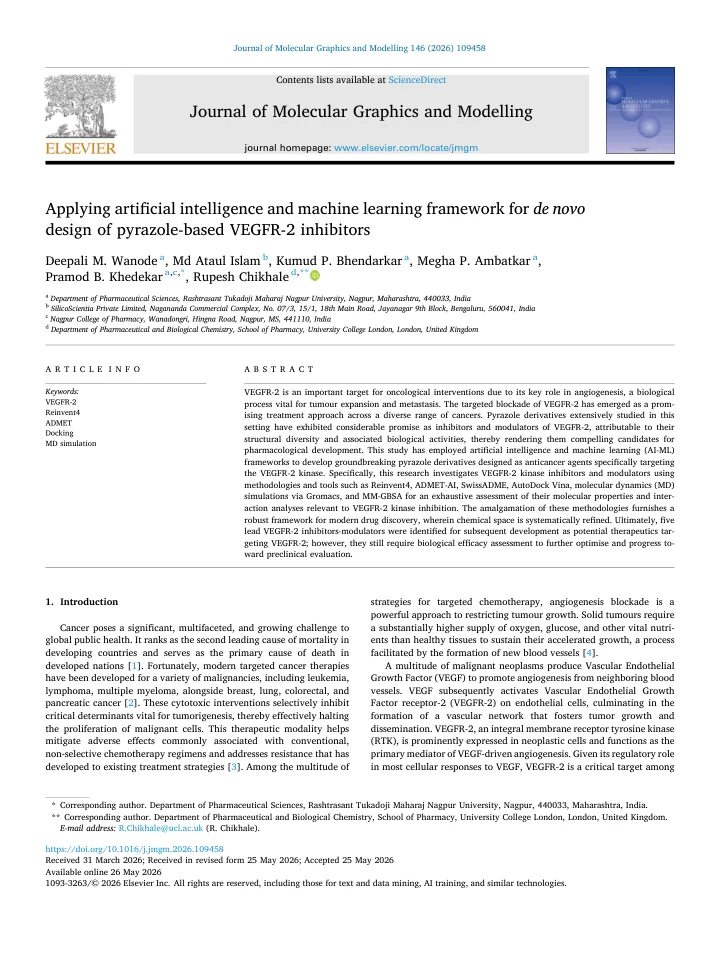
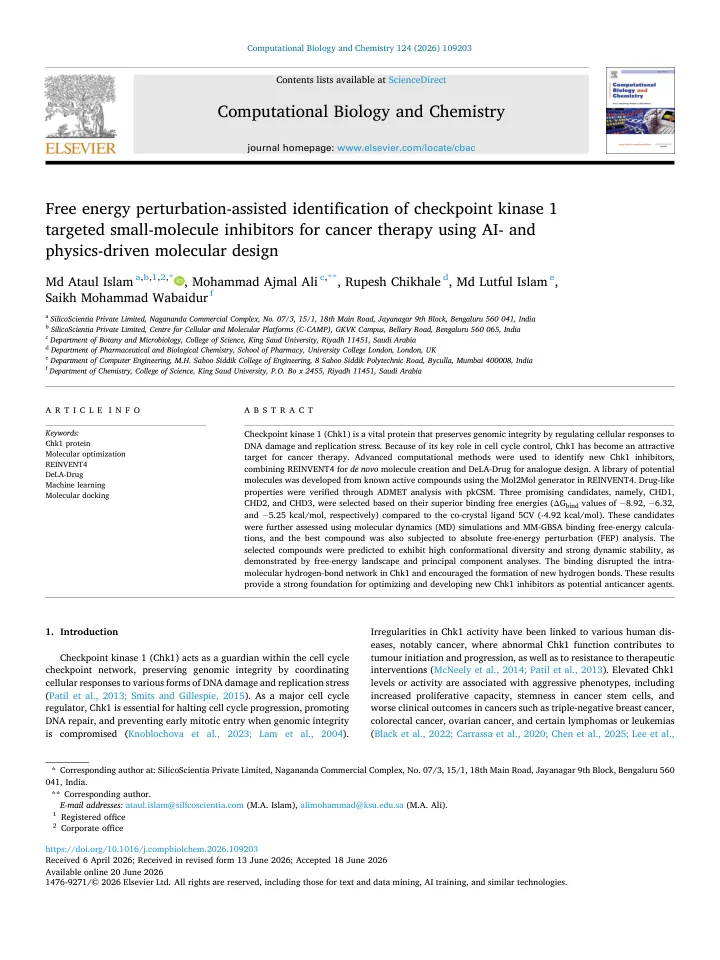
07OncologyVEGFR-2Applying artificial intelligence and machine learning framework for de novo design of pyrazole-based VEGFR-2 inhibitorsDeepali M. Wanode, Md Ataul Islam, Kumud P. Bhendarkar, Megha P. Ambatkar, Pramod B. Khedekar, Rupesh ChikhaleJournal of Molecular Graphics and Modelling2026SilicoXploreShow summary
First page of the article: Applying artificial intelligence and machine learning framework for de novo design of pyrazole-based VEGFR-2 inhibitorsFirst page

Summary

Applies REINVENT4 with ADMET screening, docking, molecular dynamics and MM-GBSA to design pyrazole-based inhibitors of VEGFR-2, a kinase central to tumour angiogenesis. Five lead inhibitors are identified; their biological efficacy has yet to be assessed.
Journal
Journal of Molecular Graphics and Modelling
Published
2026 · Volume 146 · 109458
Therapeutic area
Oncology
Target
VEGFR-2
Technology
Run on SilicoXplore
Access
Subscription journal
Read the article
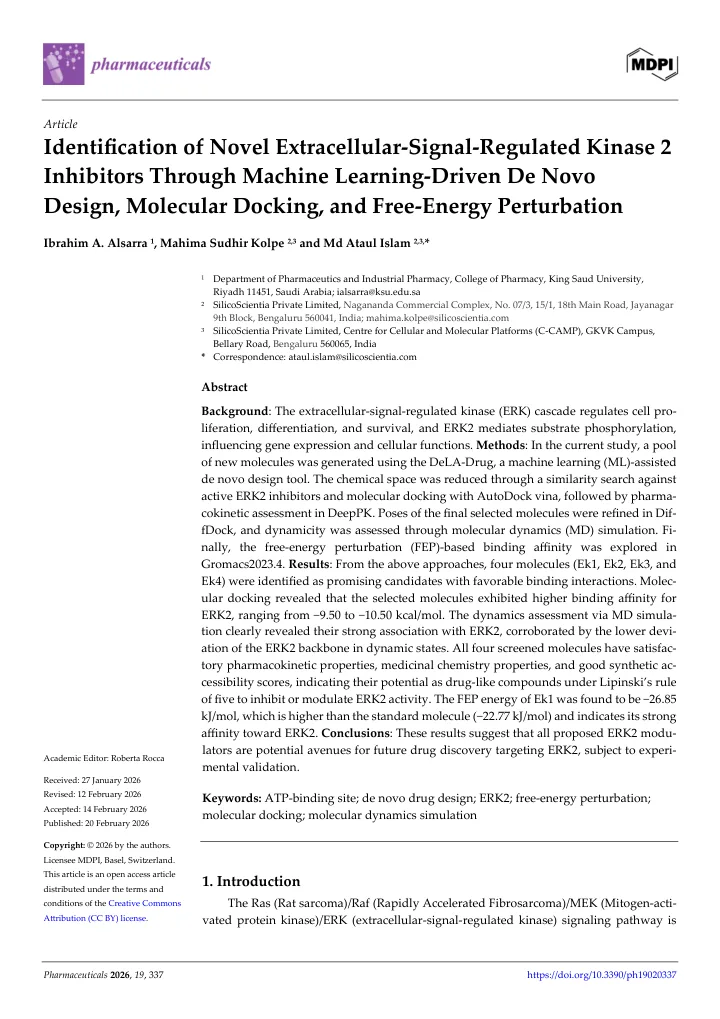
08OncologyChk1Free energy perturbation-assisted identification of checkpoint kinase 1 targeted small-molecule inhibitors for cancer therapy using AI- and physics-driven molecular designMd Ataul Islam, Mohammad Ajmal Ali, Rupesh Chikhale, Md Lutful Islam, Saikh Mohammad WabaidurComputational Biology and Chemistry2026SilicoXploreShow summary
First page of the article: Free energy perturbation-assisted identification of checkpoint kinase 1 targeted small-molecule inhibitors for cancer therapy using AI- and physics-driven molecular designFirst page

Summary

Combines REINVENT4 and DeLA-Drug to design candidate inhibitors of checkpoint kinase 1, a regulator of the response to DNA damage. Three candidates are assessed by molecular dynamics and MM-GBSA, and the best also by absolute free energy perturbation, providing a basis for further optimisation as anticancer agents.
Journal
Computational Biology and Chemistry
Published
2026 · Volume 124 · 109203
Therapeutic area
Oncology
Target
Chk1
Technology
Run on SilicoXplore
Access
Subscription journal
Read the article
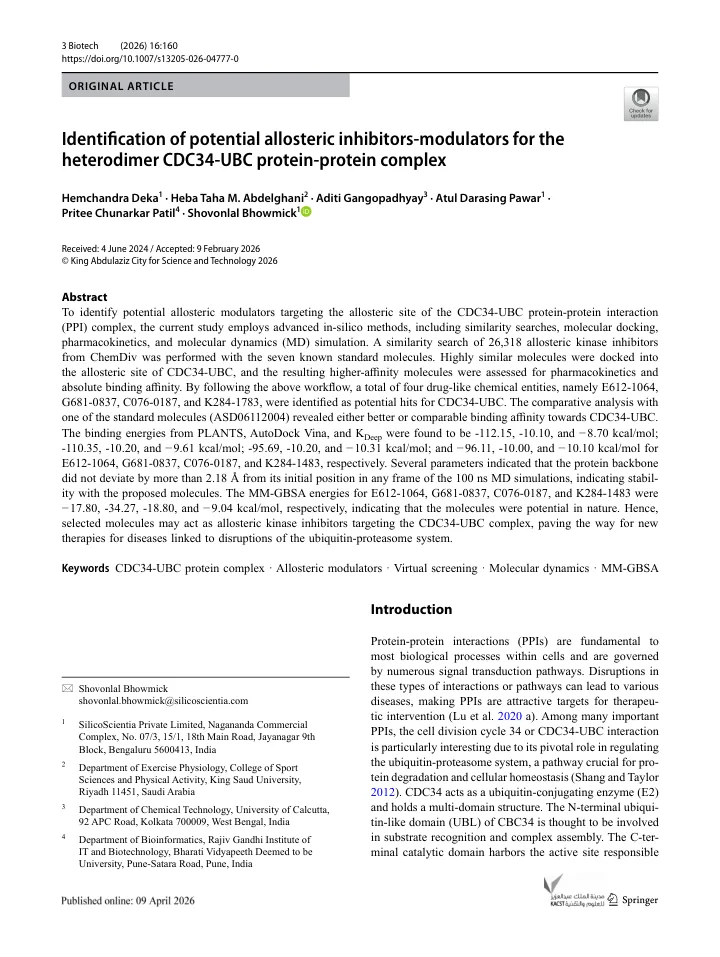
09OncologyERK2Identification of Novel Extracellular-Signal-Regulated Kinase 2 Inhibitors Through Machine Learning-Driven De Novo Design, Molecular Docking, and Free-Energy PerturbationIbrahim A. Alsarra, Mahima Sudhir Kolpe, Md Ataul IslamPharmaceuticals2026Open accessShow summary
First page of the article: Identification of Novel Extracellular-Signal-Regulated Kinase 2 Inhibitors Through Machine Learning-Driven De Novo Design, Molecular Docking, and Free-Energy PerturbationFirst page

Summary

Generates molecules with the machine-learning tool DeLA-Drug, narrows them by similarity search, docking and pharmacokinetic assessment, and refines poses and stability with DiffDock and molecular dynamics. Four candidates are identified, and free energy perturbation supports the affinity of the lead, Ek1, for ERK2, subject to experimental validation.
Journal
Pharmaceuticals
Published
2026 · Volume 19 · Issue 2 · 337
Therapeutic area
Oncology
Target
ERK2
Access
Open access
Read the article
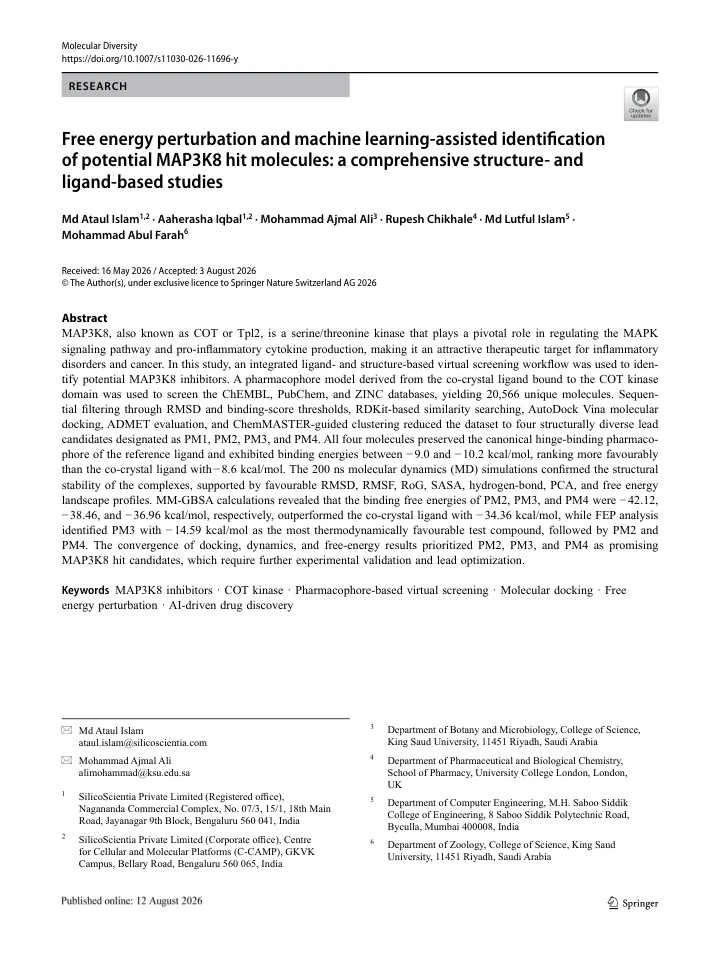
10OncologyCDC34-UBCIdentification of potential allosteric inhibitors-modulators for the heterodimer CDC34-UBC protein-protein complexHemchandra Deka, Heba Taha M. Abdelghani, Aditi Gangopadhyay, Atul Darasing Pawar, Pritee Chunarkar Patil, Shovonlal Bhowmick3 Biotech2026Show summary
First page of the article: Identification of potential allosteric inhibitors-modulators for the heterodimer CDC34-UBC protein-protein complexFirst page

Summary

Screens 26,318 allosteric kinase inhibitors from ChemDiv by similarity and docking against the allosteric site of the CDC34-UBC protein-protein complex. Four drug-like compounds are identified, and 100 ns molecular dynamics shows the protein backbone remaining stable with each of them.
Journal
3 Biotech
Published
2026 · Volume 16 · Issue 5 · 160
Therapeutic area
Oncology
Target
CDC34-UBC
Access
Subscription journal
Read the article
11OncologyMAP3K8Free energy perturbation and machine learning-assisted identification of potential MAP3K8 hit molecules: a comprehensive structure- and ligand-based studiesMd Ataul Islam, Aaherasha Iqbal, Mohammad Ajmal Ali, Rupesh Chikhale, Md Lutful Islam, Mohammad Abul FarahMolecular Diversity2026Show summary
First page of the article: Free energy perturbation and machine learning-assisted identification of potential MAP3K8 hit molecules: a comprehensive structure- and ligand-based studiesFirst page

Summary

Integrates ligand- and structure-based screening, starting from a pharmacophore derived from the co-crystal ligand and 20,566 unique molecules, to reach four structurally diverse candidates for MAP3K8, a kinase in inflammatory signalling and cancer. 200 ns molecular dynamics and MM-GBSA rank three of them above the co-crystal ligand.
Journal
Molecular Diversity
Published
2026
Therapeutic area
Oncology
Target
MAP3K8
Access
Subscription journal
Read the article
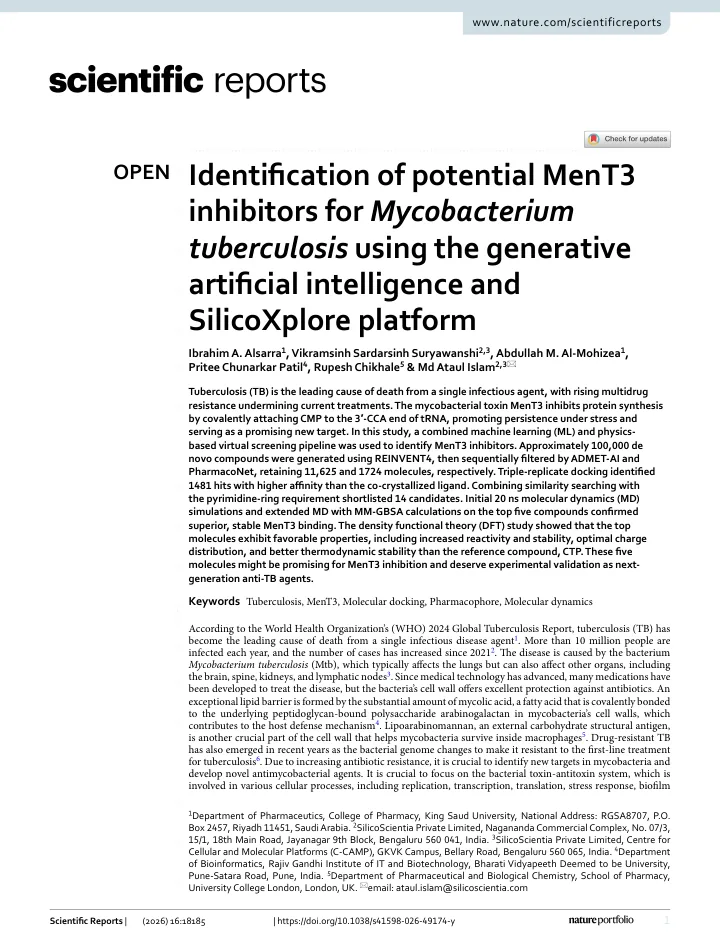
12TuberculosisMenT3Identification of potential MenT3 inhibitors for Mycobacterium tuberculosis using the generative artificial intelligence and SilicoXplore platformIbrahim A. Alsarra, Vikramsinh Sardarsinh Suryawanshi, Abdullah M. Al-Mohizea, Pritee Chunarkar Patil, Rupesh Chikhale, Md Ataul IslamScientific Reports2026SilicoXploreOpen accessShow summary
First page of the article: Identification of potential MenT3 inhibitors for Mycobacterium tuberculosis using the generative artificial intelligence and SilicoXplore platformFirst page

Summary

Applies a combined machine-learning and physics-based pipeline to the Mycobacterium tuberculosis toxin MenT3: about 100,000 de novo compounds from REINVENT4, filtered by ADMET-AI and PharmacoNet, docked in triplicate and shortlisted to 14, with molecular dynamics, MM-GBSA and density functional theory on the top five. Run on SilicoXplore; the molecules merit experimental validation.

Journal
Scientific Reports
Published
2026 · Volume 16 · Issue 1 · 18185
Therapeutic area
Tuberculosis
Target
MenT3
Technology
Run on SilicoXplore
Access
Open access
Read the article
13TuberculosisKasAFree energy perturbation and machine learning-assisted identification of novel molecules for the Mycobacterium tuberculosis KasA protein: a fragment-based drug design approachMd Ataul Islam, Mohammad Ajmal Ali, Rupesh Chikhale, Md Lutful Islam, Mohammad Abul FarahMolecular Diversity2026SilicoXploreShow summary
First page of the article: Free energy perturbation and machine learning-assisted identification of novel molecules for the Mycobacterium tuberculosis KasA protein: a fragment-based drug design approachFirst page

Summary

Uses fragment-based design: fragments from known KasA inhibitors are recombined into hit compounds and evaluated by multi-tier docking, pharmacokinetics and molecular dynamics. Five candidate molecules score better than the reference ligand TLM in docking, and MM-GBSA and free energy perturbation support their affinity, warranting experimental validation.
Journal
Molecular Diversity
Published
2026
Therapeutic area
Tuberculosis
Target
KasA
Technology
Run on SilicoXplore
Access
Subscription journal
Read the article
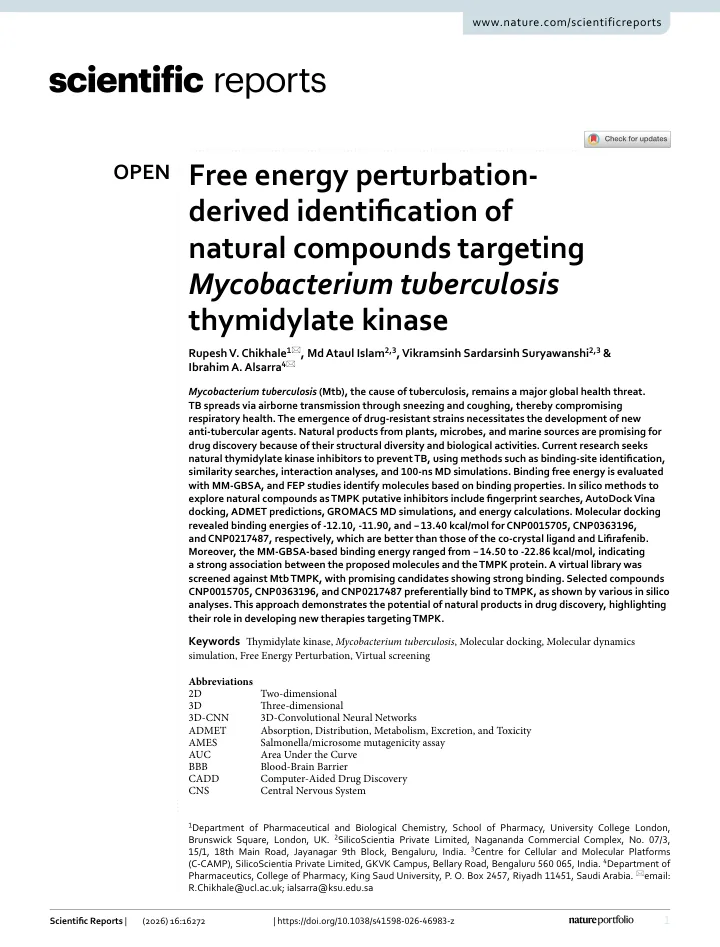
14TuberculosisTMKFree energy perturbation-derived identification of natural compounds targeting Mycobacterium tuberculosis thymidylate kinaseRupesh V. Chikhale, Md Ataul Islam, Vikramsinh Sardarsinh Suryawanshi, Ibrahim A. AlsarraScientific Reports2026Open accessShow summary
First page of the article: Free energy perturbation-derived identification of natural compounds targeting Mycobacterium tuberculosis thymidylate kinaseFirst page

Summary

Searches natural-product libraries for inhibitors of Mycobacterium tuberculosis thymidylate kinase using fingerprint search, docking, ADMET prediction and 100 ns molecular dynamics. MM-GBSA and free energy perturbation are used to rank the molecules, and three natural compounds show docking energies better than the co-crystal ligand.
Journal
Scientific Reports
Published
2026 · Volume 16 · Issue 1 · 16272
Therapeutic area
Tuberculosis
Target
TMK
Access
Open access
Read the article
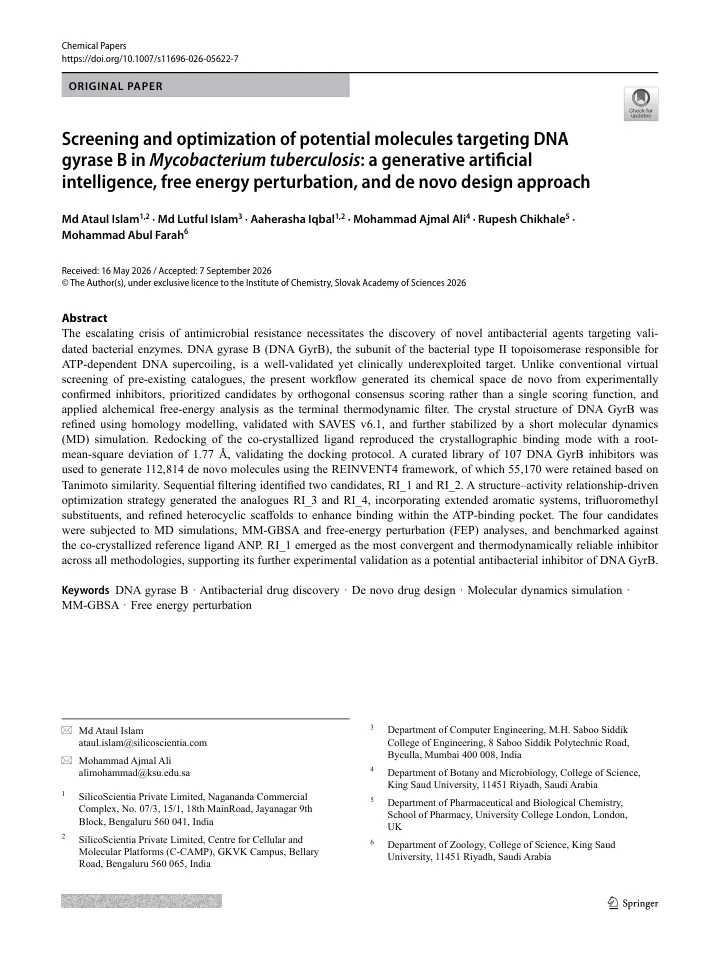
15TuberculosisDNA gyrase BScreening and optimization of potential molecules targeting DNA gyrase B in Mycobacterium tuberculosis: a generative artificial intelligence, free energy perturbation, and de novo design approachMd Ataul Islam, Md Lutful Islam, Aaherasha Iqbal, Mohammad Ajmal Ali, Rupesh Chikhale, Mohammad Abul FarahChemical Papers2026Show summary
First page of the article: Screening and optimization of potential molecules targeting DNA gyrase B in Mycobacterium tuberculosis: a generative artificial intelligence, free energy perturbation, and de novo design approachFirst page

Summary

Generates 112,814 de novo molecules from 107 known DNA gyrase B inhibitors, filters them by consensus docking scores and optimises two candidates into analogues. Four candidates are then examined by molecular dynamics, MM-GBSA and free energy perturbation; RI_1 emerges as the most consistent across methods and is proposed for experimental validation.
Journal
Chemical Papers
Published
2026
Therapeutic area
Tuberculosis
Target
DNA gyrase B
Access
Subscription journal
Read the article
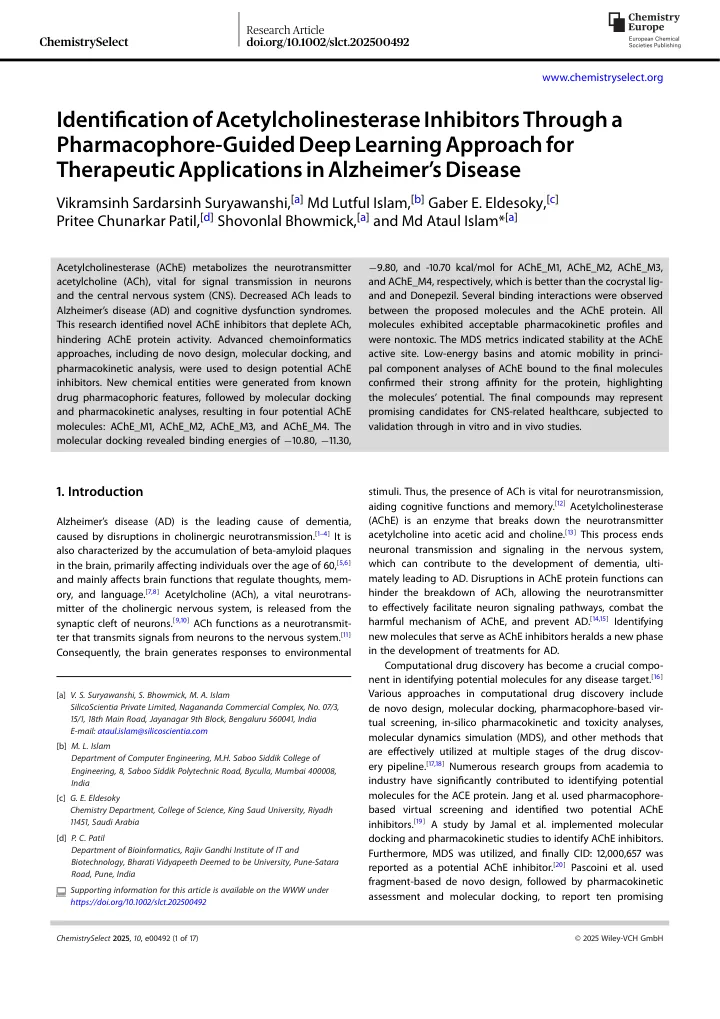
16NeurologicalAChEIdentification of Acetylcholinesterase Inhibitors Through a Pharmacophore-Guided Deep Learning Approach for Therapeutic Applications in Alzheimer's DiseaseVikramsinh Sardarsinh Suryawanshi, Md Lutful Islam, Gaber E. Eldesoky, Pritee Chunarkar Patil, Shovonlal Bhowmick, Md Ataul IslamChemistrySelect2025Show summary
First page of the article: Identification of Acetylcholinesterase Inhibitors Through a Pharmacophore-Guided Deep Learning Approach for Therapeutic Applications in Alzheimer's DiseaseFirst page

Summary

Generates new chemical entities from the pharmacophoric features of known drugs and evaluates them by docking and pharmacokinetic analysis for Alzheimer's disease. Four candidate AChE inhibitors bind more favourably than the co-crystal ligand and donepezil in docking, with molecular dynamics indicating stability at the active site.
Journal
ChemistrySelect
Published
2025 · Volume 10 · Issue 25 · e00492
Therapeutic area
Neurological
Target
AChE
Access
Subscription journal
Read the article
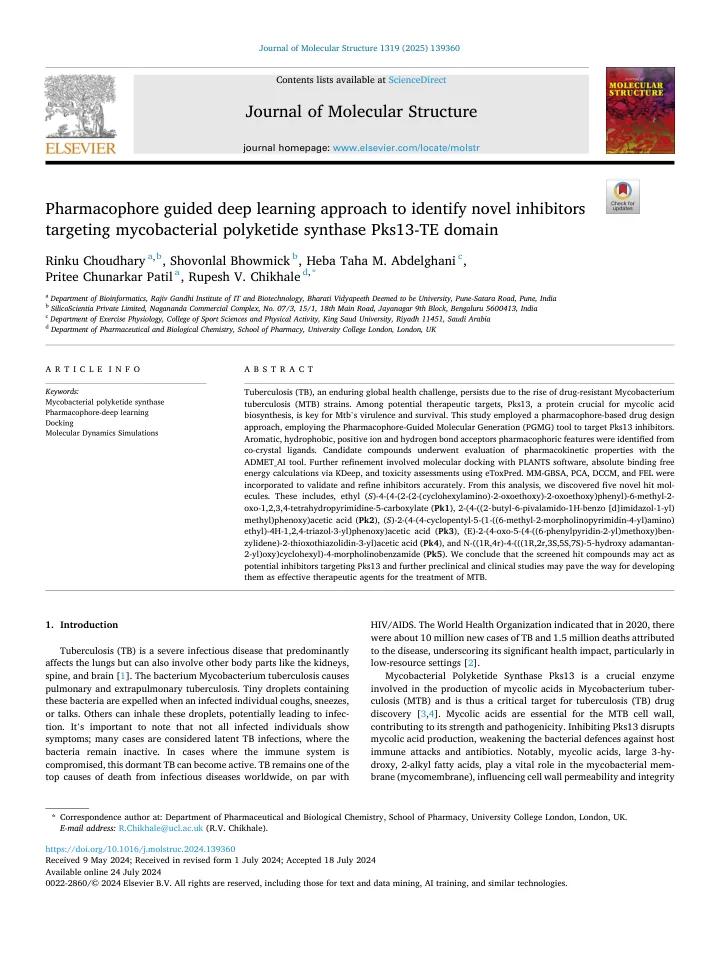
17TuberculosisPks13Pharmacophore guided deep learning approach to identify novel inhibitors targeting mycobacterial polyketide synthase Pks13-TE domainRinku Choudhary, Shovonlal Bhowmick, Heba Taha M. Abdelghani, Pritee Chunarkar Patil, Rupesh V. ChikhaleJournal of Molecular Structure2025Show summary
First page of the article: Pharmacophore guided deep learning approach to identify novel inhibitors targeting mycobacterial polyketide synthase Pks13-TE domainFirst page

Summary

Uses the Pharmacophore-Guided Molecular Generation tool to design inhibitors of the Pks13 thioesterase domain, essential for mycolic acid biosynthesis in Mycobacterium tuberculosis. Candidates were filtered by ADMET-AI, docking, absolute binding energy and toxicity assessment and refined by MM-GBSA and trajectory analyses, yielding five hit molecules.
Journal
Journal of Molecular Structure
Published
2025 · Volume 1319 · 139360
Therapeutic area
Tuberculosis
Target
Pks13
Access
Subscription journal
Read the article
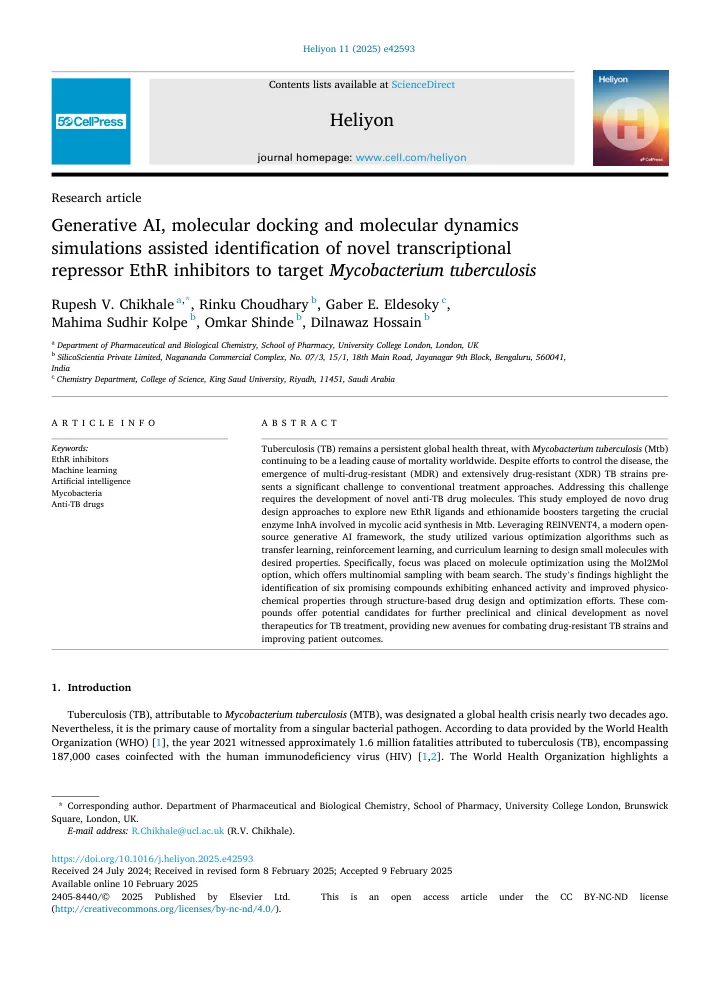
18TuberculosisEthRGenerative AI, molecular docking and molecular dynamics simulations assisted identification of novel transcriptional repressor EthR inhibitors to target Mycobacterium tuberculosisRupesh V. Chikhale, Rinku Choudhary, Gaber E. Eldesoky, Mahima Sudhir Kolpe, Omkar Shinde, Dilnawaz HossainHeliyon2025Open accessShow summary
First page of the article: Generative AI, molecular docking and molecular dynamics simulations assisted identification of novel transcriptional repressor EthR inhibitors to target Mycobacterium tuberculosisFirst page

Summary

Uses REINVENT4 with docking and molecular dynamics to design new ligands of the EthR repressor as ethionamide boosters in Mycobacterium tuberculosis. Six promising compounds with improved physicochemical properties are identified as candidates for further development against drug-resistant tuberculosis.
Journal
Heliyon
Published
2025 · Volume 11 · Issue 4 · e42593
Therapeutic area
Tuberculosis
Target
EthR
Access
Open access
Read the article
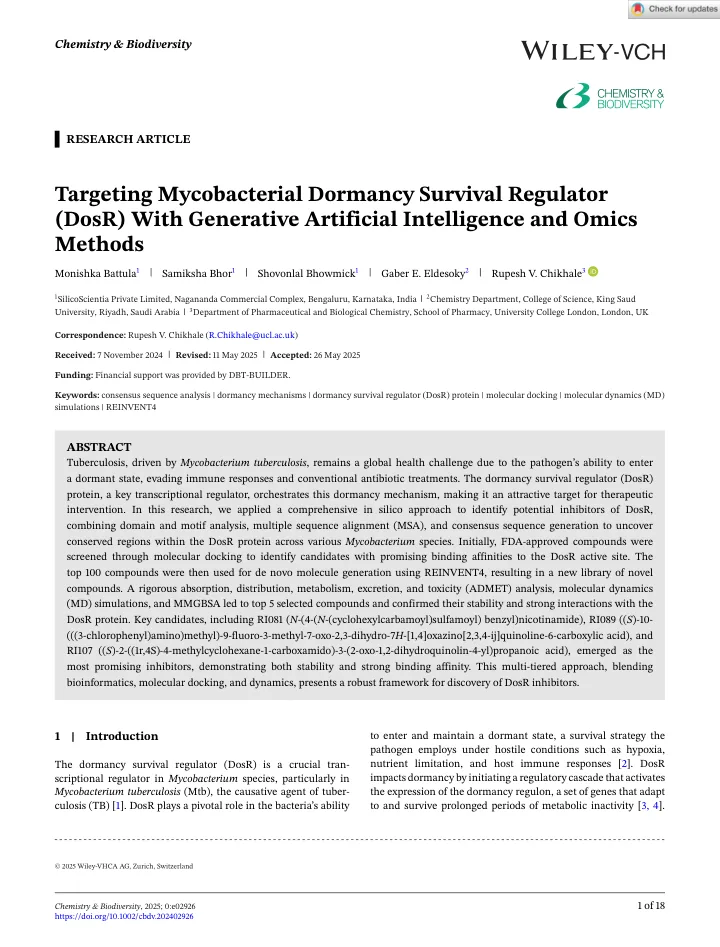
19TuberculosisDosRTargeting Mycobacterial Dormancy Survival Regulator (DosR) With Generative Artificial Intelligence and Omics MethodsMonishka Battula, Samiksha Bhor, Shovonlal Bhowmick, Gaber E. Eldesoky, Rupesh V. ChikhaleChemistry & Biodiversity2025Show summary
First page of the article: Targeting Mycobacterial Dormancy Survival Regulator (DosR) With Generative Artificial Intelligence and Omics MethodsFirst page

Summary

Combines sequence analysis of DosR across mycobacterial species with docking of FDA-approved compounds, de novo generation from the top 100 using REINVENT4, ADMET analysis, molecular dynamics and MM-GBSA. Five compounds are selected as stable binders of DosR, the regulator of mycobacterial dormancy.
Journal
Chemistry & Biodiversity
Published
2025 · e02926
Therapeutic area
Tuberculosis
Target
DosR
Access
Subscription journal
Read the article
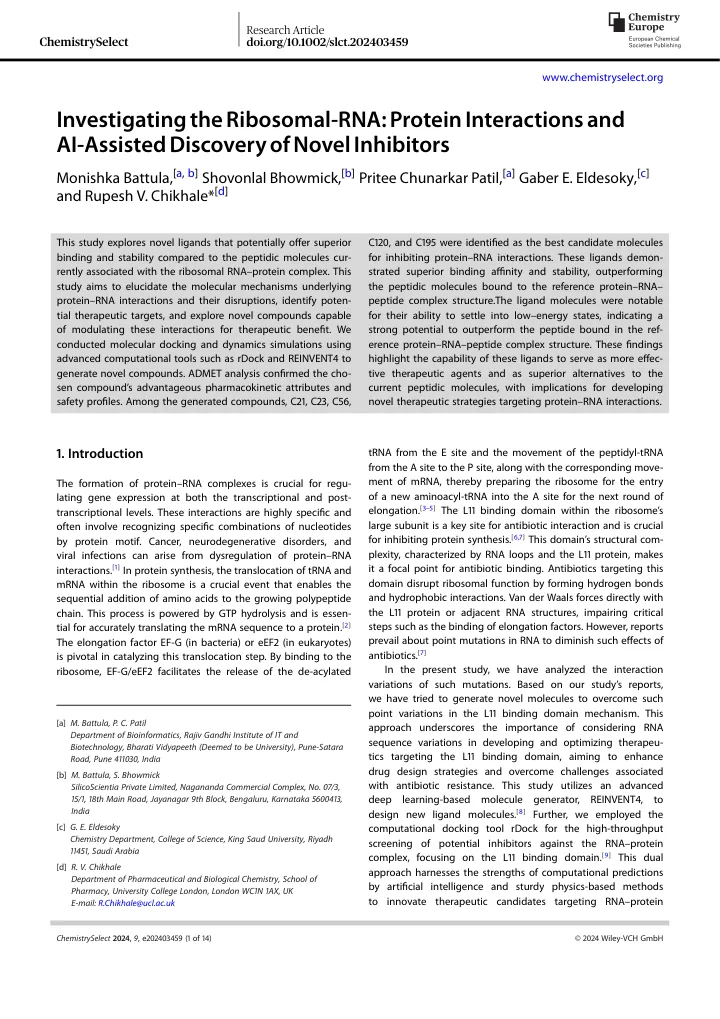
20Antimicrobial resistanceRibosomal RNAInvestigating the Ribosomal-RNA: Protein Interactions and AI-Assisted Discovery of Novel InhibitorsMonishka Battula, Shovonlal Bhowmick, Pritee Chunarkar Patil, Gaber E. Eldesoky, Rupesh V. ChikhaleChemistrySelect2024Show summary
First page of the article: Investigating the Ribosomal-RNA: Protein Interactions and AI-Assisted Discovery of Novel InhibitorsFirst page

Summary

Studies the interaction between ribosomal RNA and protein and uses rDock and REINVENT4 to generate and evaluate new ligands. Five candidate molecules show stronger binding and stability than the peptide in the reference complex, with favourable pharmacokinetic and safety profiles.
Journal
ChemistrySelect
Published
2024 · Volume 9 · Issue 43 · e202403459
Therapeutic area
Antimicrobial resistance
Target
Ribosomal RNA
Access
Subscription journal
Read the article
21OncologyPeregrinIdentification of Peregrin inhibitors-modulators by harnessing the computational prowess of molecular simulation and machine learning algorithmsHemchandra Deka, Atul Darasing Pawar, Monishka Srinivas Battula, Gaber E. Eldesoky, Omkar Dilip Shinde, Pritee Chunarkar Patil, Tapan Kumar Mistri, Hitesh Vishwanath Shahare, Shovonlal BhowmickJournal of Molecular Liquids2024Show summary
First page of the article: Identification of Peregrin inhibitors-modulators by harnessing the computational prowess of molecular simulation and machine learning algorithmsFirst page

Summary

Screens 5,430 bromodomain-directed compounds from ChemDiv by docking with two scoring functions and machine-learning binding-affinity prediction, followed by pharmacokinetics and 100 ns molecular dynamics. Four compounds hold their interaction with Peregrin over the simulation, with K788-9421 the most favourable; extensive experimental validation is needed.
Journal
Journal of Molecular Liquids
Published
2024 · Volume 411 · 125782
Therapeutic area
Oncology
Target
Peregrin
Access
Subscription journal
Read the article
22OncologyHsp90Machine Learning Aided De Novo Design Identifies Novel Benzimidazolone Based Inhibitor-Modulators for Heat Shock Protein 90 (HSP90)Shovonlal Bhowmick, Jagriti Malhotra, Rinku Choudhary, Omkar Dilip Shinde, Ahmed Sayed M. Metwally, Pritee Chunarkar PatilChemistrySelect2024Show summary
First page of the article: Machine Learning Aided De Novo Design Identifies Novel Benzimidazolone Based Inhibitor-Modulators for Heat Shock Protein 90 (HSP90)First page

Summary

Uses REINVENT4 to generate molecules against known HSP90 inhibitors, then reduces the chemical space by pharmacokinetics, docking and machine-learning absolute binding affinity. Three benzimidazole-based candidates, IM1 to IM3, are examined in 100 ns molecular dynamics and MM-GBSA.
Journal
ChemistrySelect
Published
2024 · Volume 9 · Issue 31 · e202402147
Therapeutic area
Oncology
Target
Hsp90
Access
Subscription journal
Read the article
23OncologyERK2Machine learning-integrated and fingerprint-based similarity search against immuno oncology library for identification of novel ERK2 inhibitorsVikramsinh Sardarsinh Suryawanshi, Surbhi Pravin Pawar, Mahima Sudhir Kolpe, Heba Taha M. Abdelghani, Sonali Chikhale, Pritee Chunarkar Patil, Shovonlal BhowmickStructural Chemistry2024Show summary
First page of the article: Machine learning-integrated and fingerprint-based similarity search against immuno oncology library for identification of novel ERK2 inhibitorsFirst page

Summary

Combines a similarity search of an immuno-oncology library, based on known kinase inhibitors, with docking and AI/ML pharmacokinetic filtering to select ERK2 leads. 300 ns molecular dynamics, with RMSD, radius of gyration, fluctuation, hydrogen-bond and MM-GBSA analyses, confirms the association of the selected complexes.
Journal
Structural Chemistry
Published
2024 · Volume 36 · Issue 2 · 681-700
Therapeutic area
Oncology
Target
ERK2
Access
Subscription journal
Read the article
24OncologyCHK2Identification of Potent CHK2 Inhibitors-Modulators for Therapeutic Application in Cancer: A Machine Learning Integrated Fragment-Based Drug Design ApproachMahima Sudhir Kolpe, Vikramsinh Sardarsinh Suryawanshi, Gaber E. Eldesoky, Dilnawaz Hossain, Pritee Chunarkar Patil, Shovonlal BhowmickChemistrySelect2024Show summary
First page of the article: Identification of Potent CHK2 Inhibitors-Modulators for Therapeutic Application in Cancer: A Machine Learning Integrated Fragment-Based Drug Design ApproachFirst page

Summary

Applies fragment-based design: fragments from known CHK2 inhibitor scaffolds, generated with MacFrag and screened by similarity, are assembled with Fragmenstein into new molecules, then assessed by docking, pharmacokinetics and molecular dynamics. Five novel compounds are proposed as CHK2 inhibitors.
Journal
ChemistrySelect
Published
2024 · Volume 9 · Issue 39 · e202403302
Therapeutic area
Oncology
Target
CHK2
Access
Subscription journal
Read the article
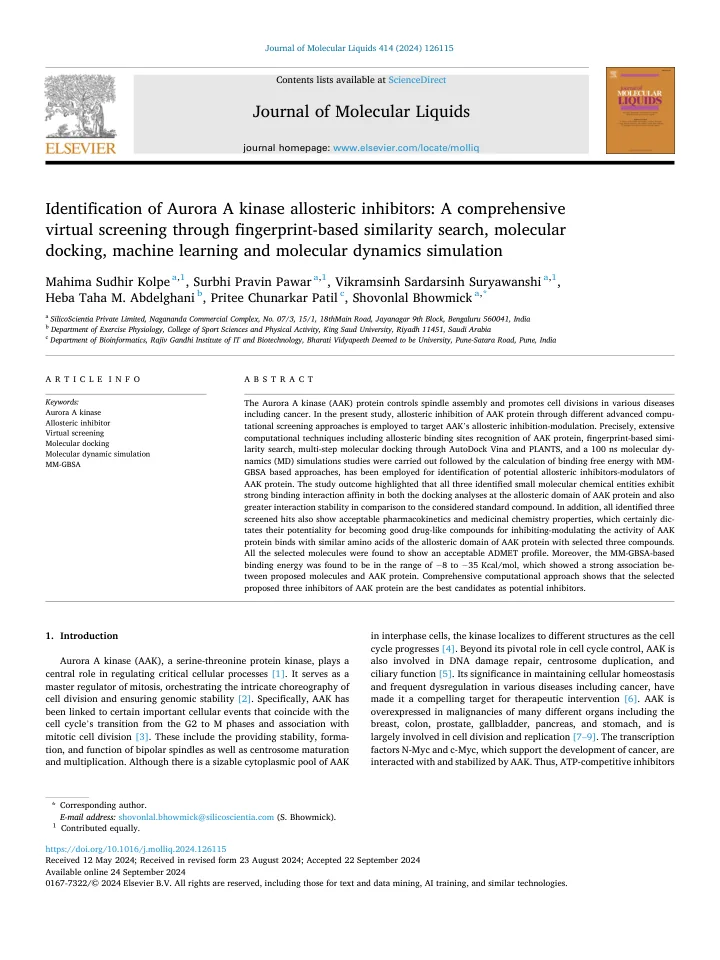
25OncologyAurora A kinaseIdentification of Aurora A kinase allosteric inhibitors: A comprehensive virtual screening through fingerprint-based similarity search, molecular docking, machine learning and molecular dynamics simulationMahima Sudhir Kolpe, Surbhi Pravin Pawar, Vikramsinh Sardarsinh Suryawanshi, Heba Taha M. Abdelghani, Pritee Chunarkar Patil, Shovonlal BhowmickJournal of Molecular Liquids2024Show summary
First page of the article: Identification of Aurora A kinase allosteric inhibitors: A comprehensive virtual screening through fingerprint-based similarity search, molecular docking, machine learning and molecular dynamics simulationFirst page

Summary

Targets the allosteric site of Aurora A kinase through site recognition, fingerprint similarity search, multi-step docking with AutoDock Vina and PLANTS, and 100 ns molecular dynamics with MM-GBSA analysis, to identify allosteric inhibitors and modulators.
Journal
Journal of Molecular Liquids
Published
2024 · Volume 414 · 126115
Therapeutic area
Oncology
Target
Aurora A kinase
Access
Subscription journal
Read the article
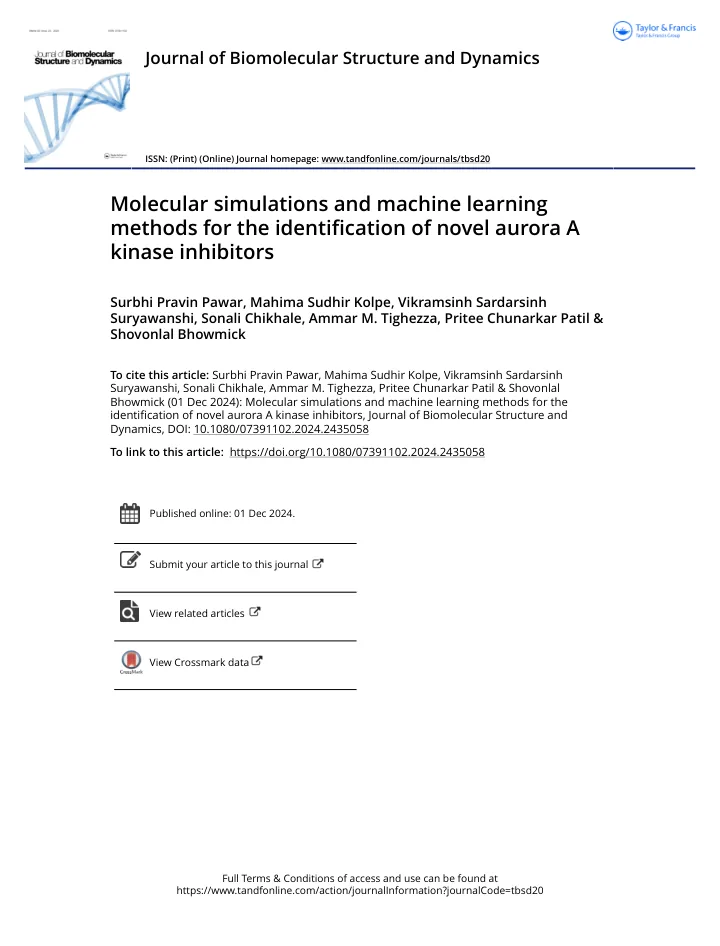
26OncologyAurora A kinaseMolecular simulations and machine learning methods for the identification of novel aurora A kinase inhibitorsSurbhi Pravin Pawar, Mahima Sudhir Kolpe, Vikramsinh Sardarsinh Suryawanshi, Sonali Chikhale, Ammar M. Tighezza, Pritee Chunarkar Patil, Shovonlal BhowmickJournal of Biomolecular Structure and Dynamics2024Show summary
First page of the article: Molecular simulations and machine learning methods for the identification of novel aurora A kinase inhibitorsFirst page

Summary

Screens a ChemDiv kinase-inhibitor library against Aurora A kinase, a regulator of mitosis implicated in cancer, using multi-step docking with AutoDock Vina and PLANTS, absolute binding energy estimation and molecular dynamics. Three hit compounds bind the active site in a mode similar to the reference ligand VX-680.
Journal
Journal of Biomolecular Structure and Dynamics
Published
2024 · Volume 43 · Issue 14 · 7797-7810
Therapeutic area
Oncology
Target
Aurora A kinase
Access
Subscription journal
Read the article
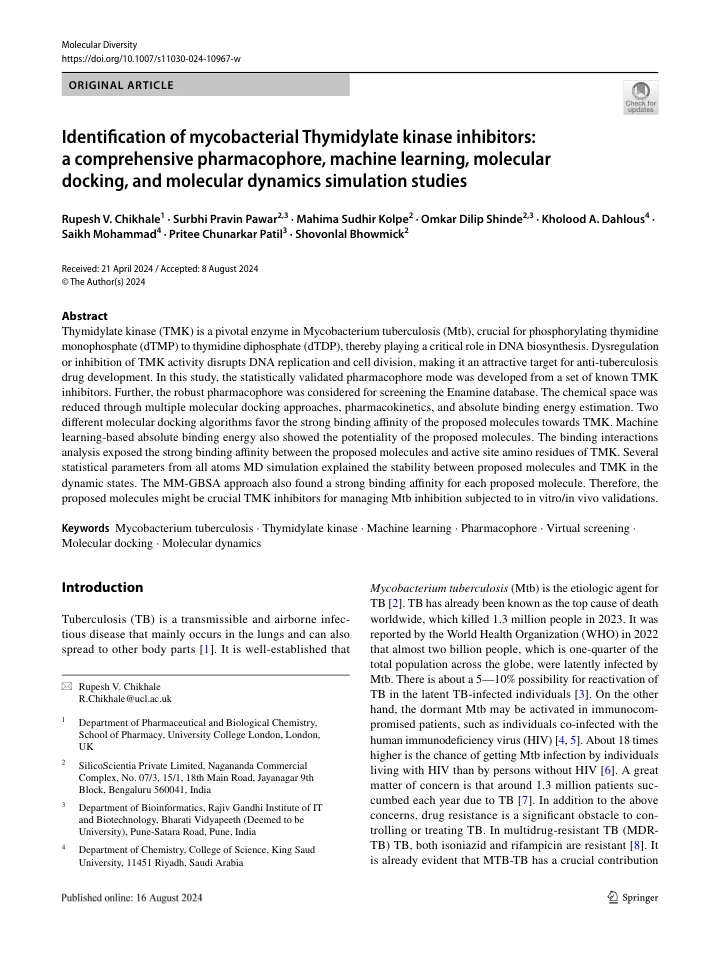
27TuberculosisTMKIdentification of mycobacterial Thymidylate kinase inhibitors: a comprehensive pharmacophore, machine learning, molecular docking, and molecular dynamics simulation studiesRupesh V. Chikhale, Surbhi Pravin Pawar, Mahima Sudhir Kolpe, Omkar Dilip Shinde, Kholood A. Dahlous, Saikh Mohammad, Pritee Chunarkar Patil, Shovonlal BhowmickMolecular Diversity2024Open accessShow summary
First page of the article: Identification of mycobacterial Thymidylate kinase inhibitors: a comprehensive pharmacophore, machine learning, molecular docking, and molecular dynamics simulation studiesFirst page

Summary

Builds a statistically validated pharmacophore model from known mycobacterial thymidylate kinase inhibitors and screens the Enamine database, reducing the chemical space by docking, pharmacokinetics and machine-learning binding energy. Molecular dynamics and MM-GBSA support strong, stable binding, subject to in vitro and in vivo validation.
Journal
Molecular Diversity
Published
2024 · Volume 28 · Issue 4 · 1947-1964
Therapeutic area
Tuberculosis
Target
TMK
Access
Open access
Read the article
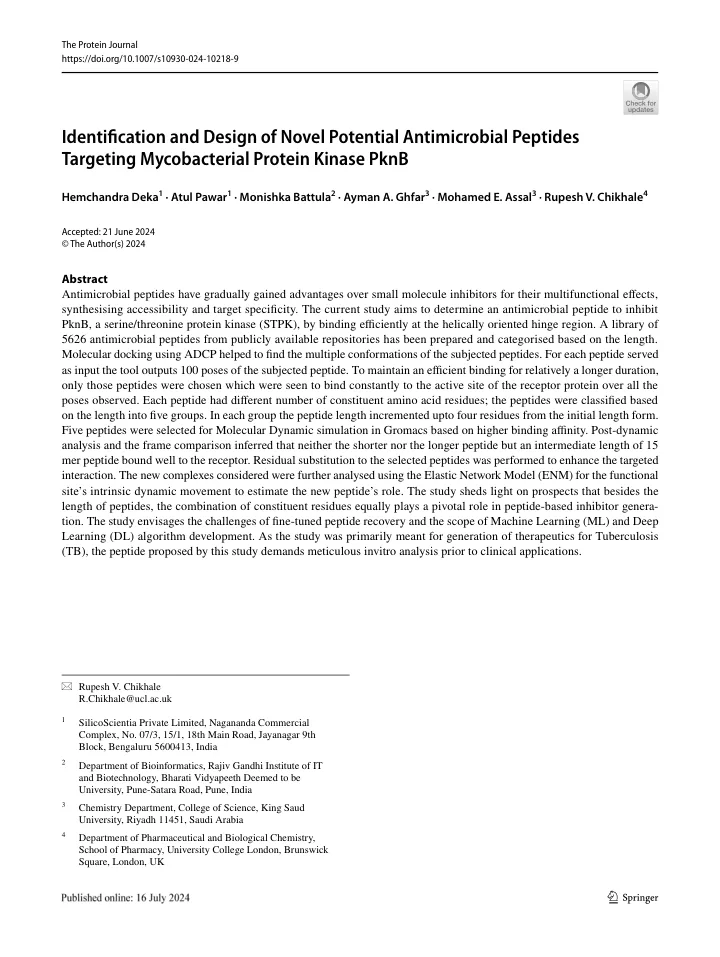
28TuberculosisPknBIdentification and Design of Novel Potential Antimicrobial Peptides Targeting Mycobacterial Protein Kinase PknBHemchandra Deka, Atul Pawar, Monishka Battula, Ayman A. Ghfar, Mohamed E. Assal, Rupesh V. ChikhaleThe Protein Journal2024Open accessShow summary
First page of the article: Identification and Design of Novel Potential Antimicrobial Peptides Targeting Mycobacterial Protein Kinase PknBFirst page

Summary

Docks a library of 5,626 antimicrobial peptides to the PknB kinase domain, selects binders by length and affinity, and examines five in molecular dynamics. A 15-residue peptide binds best, and residue substitution and elastic network analysis are used to refine it; in vitro analysis is needed before any clinical application.
Journal
The Protein Journal
Published
2024 · Volume 43 · Issue 4 · 858-868
Therapeutic area
Tuberculosis
Target
PknB
Access
Open access
Read the article
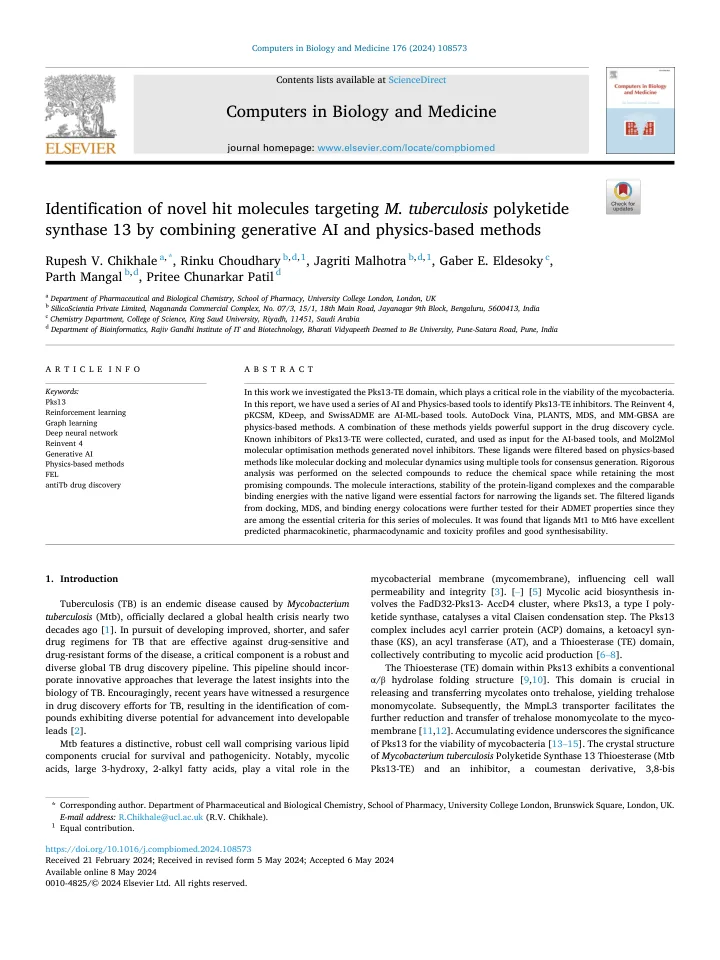
29TuberculosisPks13Identification of novel hit molecules targeting M. tuberculosis polyketide synthase 13 by combining generative AI and physics-based methodsRupesh V. Chikhale, Rinku Choudhary, Jagriti Malhotra, Gaber E. Eldesoky, Parth Mangal, Pritee Chunarkar PatilComputers in Biology and Medicine2024Show summary
First page of the article: Identification of novel hit molecules targeting M. tuberculosis polyketide synthase 13 by combining generative AI and physics-based methodsFirst page

Summary

Combines AI-based tools (REINVENT4, pkCSM, KDeep, SwissADME) with physics-based methods (docking, molecular dynamics, MM-GBSA) to design inhibitors of the Pks13 thioesterase domain from known inhibitors. Six ligands, Mt1 to Mt6, show favourable predicted pharmacokinetic and toxicity profiles and good synthesisability.
Journal
Computers in Biology and Medicine
Published
2024 · Volume 176 · 108573
Therapeutic area
Tuberculosis
Target
Pks13
Access
Subscription journal
Read the article
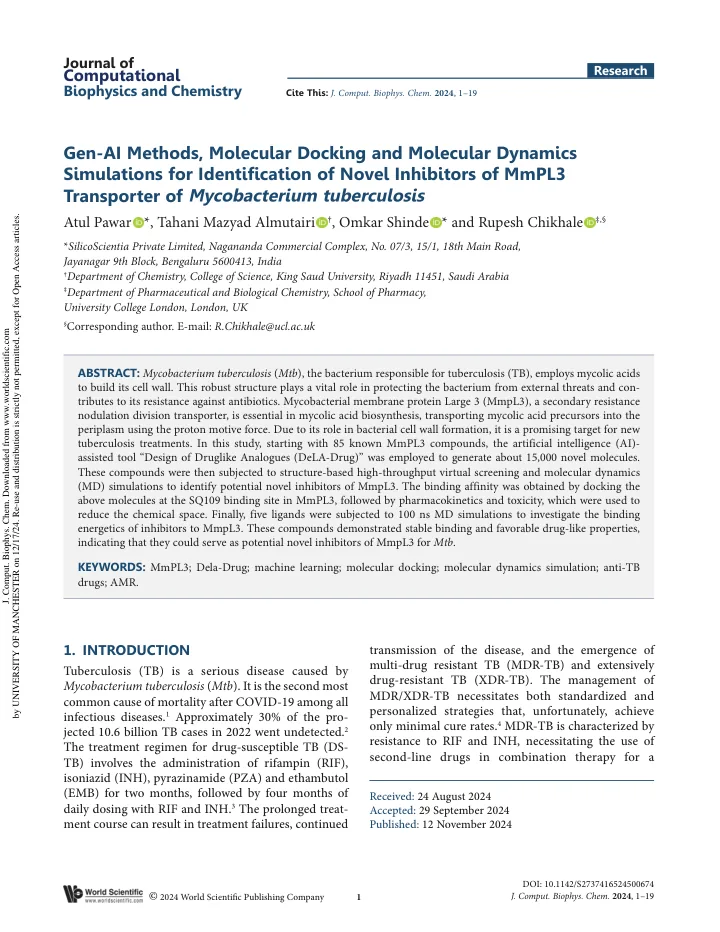
30TuberculosisMmpL3Gen-AI Methods, Molecular Docking and Molecular Dynamics Simulations for Identification of Novel Inhibitors of MmPL3 Transporter of Mycobacterium tuberculosisAtul Pawar, Tahani Mazyad Almutairi, Omkar Shinde, Rupesh ChikhaleJournal of Computational Biophysics and Chemistry2024Show summary
First page of the article: Gen-AI Methods, Molecular Docking and Molecular Dynamics Simulations for Identification of Novel Inhibitors of MmPL3 Transporter of Mycobacterium tuberculosisFirst page

Summary

Starts from 85 known MmpL3 compounds and uses DeLA-Drug to generate about 15,000 molecules, which are docked at the SQ109 binding site and filtered by pharmacokinetics and toxicity. Five ligands show stable binding and drug-like properties in 100 ns molecular dynamics.
Journal
Journal of Computational Biophysics and Chemistry
Published
2024 · Volume 24 · Issue 04 · 471-489
Therapeutic area
Tuberculosis
Target
MmpL3
Access
Subscription journal
Read the article
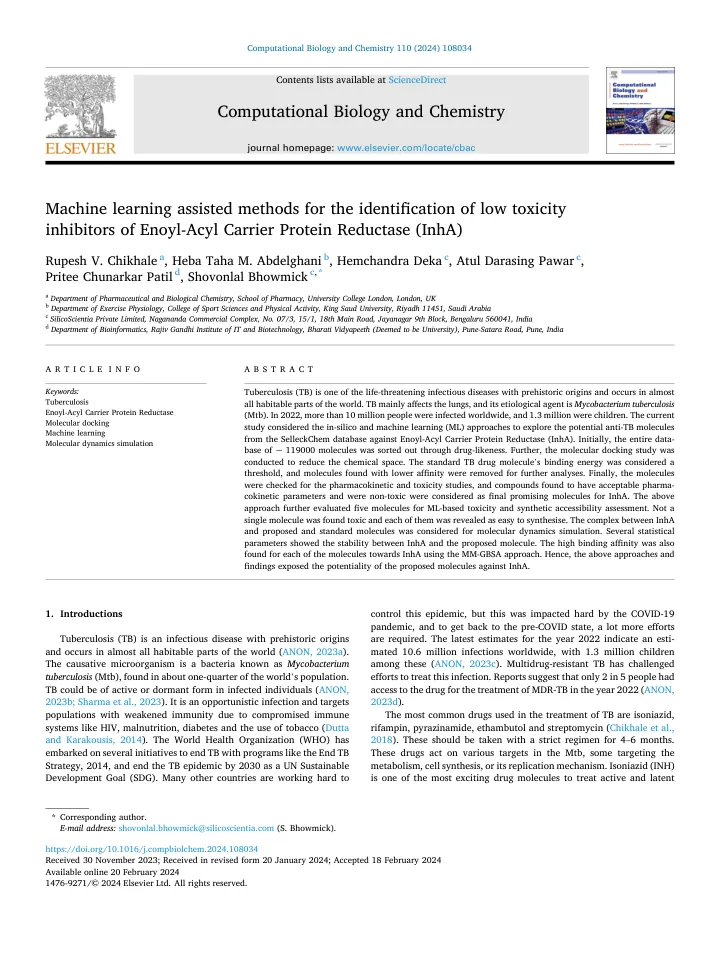
31TuberculosisInhAMachine learning assisted methods for the identification of low toxicity inhibitors of Enoyl-Acyl Carrier Protein Reductase (InhA)Rupesh V. Chikhale, Heba Taha M. Abdelghani, Hemchandra Deka, Atul Darasing Pawar, Pritee Chunarkar Patil, Shovonlal BhowmickComputational Biology and Chemistry2024Show summary
First page of the article: Machine learning assisted methods for the identification of low toxicity inhibitors of Enoyl-Acyl Carrier Protein Reductase (InhA)First page

Summary

Screens about 119,000 molecules from the SelleckChem database for InhA inhibitors using drug-likeness, docking against a standard-drug threshold, and pharmacokinetic and toxicity filters. Five molecules are assessed as non-toxic and readily synthesisable by machine learning, and molecular dynamics and MM-GBSA support stable, high-affinity binding.
Journal
Computational Biology and Chemistry
Published
2024 · Volume 110 · 108034
Therapeutic area
Tuberculosis
Target
InhA
Access
Subscription journal
Read the article
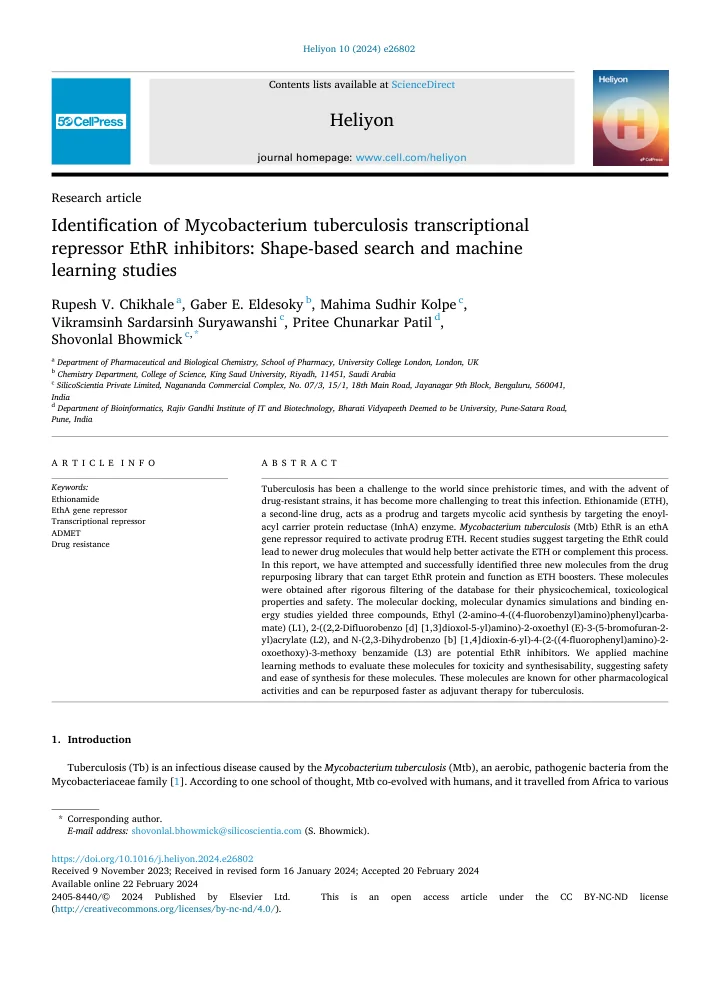
32TuberculosisEthRIdentification of Mycobacterium tuberculosis transcriptional repressor EthR inhibitors: Shape-based search and machine learning studiesRupesh V. Chikhale, Gaber E. Eldesoky, Mahima Sudhir Kolpe, Vikramsinh Sardarsinh Suryawanshi, Pritee Chunarkar Patil, Shovonlal BhowmickHeliyon2024Open accessShow summary
First page of the article: Identification of Mycobacterium tuberculosis transcriptional repressor EthR inhibitors: Shape-based search and machine learning studiesFirst page

Summary

Identifies three molecules from a drug repurposing library as potential EthR inhibitors that could act as ethionamide boosters in tuberculosis, after physicochemical, toxicological and safety filtering, docking, molecular dynamics and binding energy studies. Machine learning suggests they are safe and easy to synthesise, and their known activities may allow faster repurposing as adjuvant therapy.

Journal
Heliyon
Published
2024 · Volume 10 · Issue 5 · e26802
Therapeutic area
Tuberculosis
Target
EthR
Access
Open access
Read the article

Open access means the publisher's own page is free to read under an open licence. Status as recorded by OpenAlex on 12 October 2026.

Take the record with you

All 32 papers with their authors, journals, volumes, DOIs and open access status, for a reference manager or for due diligence. Titles, authors and pages come from Crossref, the publishers' own record.

Check it yourself

Every title links to its DOI at the publisher. For an independent view of the record, see the profile of our Head of Science, Dr. Md Ataul Islam, on Google Scholar and ORCID.

Work with us

Put the methods to work
on your target.

The same technologies and the same scientists behind these papers are available to your programme, whether you license the software, run a campaign with us, or train your team.